

Photo: illustrative — an elderly woman discussing medication options with a pharmacist at a pharmacy counter. Stock photo by cottonbro studio via Pexels.
A medication review for elderly parents is a sit-down with your parent's doctor or pharmacist to go through every pill, vitamin, and over-the-counter remedy they take and ask three questions about each one: does your parent still need it, is the dose still right for them now, and does it clash with anything else they're taking? You can request one at the next appointment, at the pharmacy counter, or as part of an annual wellness visit — and if your parent has a Medicare drug plan, ask whether they qualify for a free review under the plan's medication therapy management program. Most families never ask. Most should.
Imagine this: say your mom is 78, living on her own, and doing fine — mostly. Then one Sunday you open her kitchen cabinet and count the bottles. There's the blood pressure pill from her cardiologist. The water pill from her primary care doctor. Something for sleep, something for her knees, a stomach pill, two vitamins, and a bottle of painkillers from a dentist visit six months ago that she still takes "when it acts up." That's eight — and nobody, not one person, has ever looked at all eight together.
That's how most medication lists grow: one good decision at a time, by different doctors, in different offices, over years. Nobody did anything wrong. But the list itself has become a risk. Taking five or more regular medications — doctors call it polypharmacy — is now so common that nearly half of people over 65 take that many, and the risk isn't one bad pill. It's the pile-up: the sleep pill that makes the morning blood pressure pill hit harder, the combination that leaves her a little unsteady on the stairs.
Earlier this month, researchers in the UK published a new tool that scores the medications most linked to falls and confusion in older adults. The science is catching up to what families already feel in their gut: the list needs a fresh pair of eyes, regularly.
How Do I Ask for a Medication Review for an Elderly Parent?
You don't need a special form, and you don't need to wait for a crisis. At your parent's next appointment — or with a quick call to the office — say this: "I'd like a medication review. Can we go through everything she's taking and check whether it's all still needed?" That's it. Doctors hear this request all the time, and most welcome it — a patient who brings a family member and a complete list is a patient they can actually help.
You can also ask at the pharmacy. Pharmacists do medication reviews every day, they see the full list across every prescriber because they fill all of it, and they're often the first to notice when two prescriptions don't get along. If your parent uses one pharmacy for everything, that pharmacist is one of the most underused experts in your parent's care.
If your parent resists — and plenty do, because a review can feel like an accusation — frame it as maintenance, not suspicion. "Your car gets an oil change. Your pills deserve the same." The review isn't about taking things away. It's about making sure every pill on that list is still earning its place.
What Should I Bring to a Medication Review?
Bring everything. Pharmacists have a name for this: the brown bag review. Put every bottle, box, and blister pack in a bag — prescriptions, over-the-counter painkillers, vitamins, eye drops, creams, the herbal remedy your aunt swore by — and bring the bag. Half of medication problems hide in the things families forget to mention because they don't think of them as "real" medicine.
Bring the list too, if you have one: drug name, dose, when it's taken, and who prescribed it. And bring your observations — the small things you notice are the most useful part of the visit. Write them down beforehand, because you will forget them in the exam room: she's drowsier in the afternoons than she used to be; she got dizzy standing up twice last week; she's been skipping the evening pill because it upsets her stomach. A doctor can only work with what you tell them.
What Happens During a Medication Review?
The doctor or pharmacist goes through the list, pill by pill, and asks three questions about each one. First: does she still need it? Medications prescribed for a short-term problem — an infection, a flare-up, a recovery — sometimes keep getting refilled for years after the problem is gone. Second: is the dose still right? A dose that was perfect at 65 can be too strong at 78. Third: does it clash with anything else? Two drugs that are fine alone can be a problem together, and no single prescription visit would ever catch that.
Sometimes a medication gets stopped or a dose gets lowered — doctors call this deprescribing, a normal, careful part of good care, not a punishment. Sometimes nothing changes, and that's a good result too: now you know the list has been checked, by a professional, on a date you can write down. Either way, leave with an updated list in writing — one list, current, that every sibling and every doctor can work from. And get the review done once a year at minimum, and again every time something changes: a new prescription, a hospital stay, a fall, new confusion or drowsiness. The days after a hospital discharge are the highest-risk moment of all, because prescriptions change in the hospital and the home list doesn't always catch up.
Why I Built FairNest
I built FairNest because the medication list was always the thing that fell apart first in my own family — a paper list on the fridge that was three months out of date, a group chat full of "did Mom take the blue one?" and nobody quite sure. So I built one shared Nest where the whole family works from the same medication list, every dose gets logged as Given or Skipped, and when something changes, the note goes to everyone at once. It's my own app, built for families like ours.
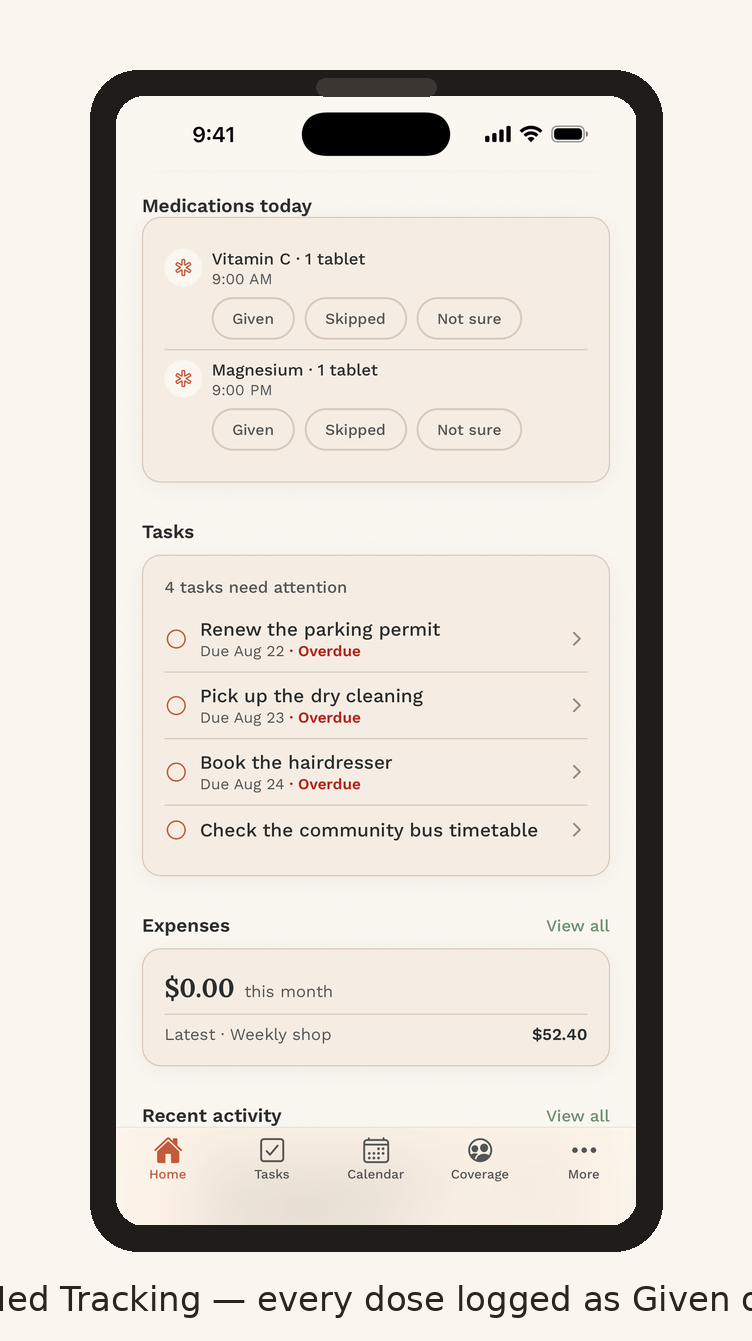
FairNest Med Tracking — every dose logged as Given or Skipped, so no one has to guess.
You don't need to understand pharmacology to protect your parent. Ask for the review, bring the bag, write down what you notice, and leave with a list everyone trusts. That's the whole job — and it's one of the highest-leverage hours you'll ever spend on your parent's care.
Bottom line: A medication review is a once-a-year sit-down with your parent's doctor or pharmacist to check every pill against three questions: still needed, dose still right, and safe together. Bring every bottle in a bag, bring your observations, and leave with one written list the whole family can trust. The pile-up is the risk — and a review is how you catch it.
This post is general information, not medical advice — talk to your parent's doctor or pharmacist about what's right for them. FairNest is my family caregiving app — one shared Nest for tasks, coverage, handoff notes, cost splitting, and med tracking. Find it free on the App Store at https://apple.co/4xRXJuq and on Google Play at https://play.google.com/store/apps/details?id=com.bizvizorllc.fairnest, and follow along at https://www.instagram.com/fairnestapp/.