

Photo: illustrative — a woman sitting alone on the sofa after a long day. Stock photo by Pavel Danilyuk via Pexels.
Caregiver resentment — the guilt, the exhaustion, the "why is it always me?" thought — is normal. It means the load has gotten lopsided, not that you love your parent less. It usually points at one specific unfairness: a sibling who never offers, a schedule only you know, a life put on hold. Name the feeling, trace it to the unfairness underneath, and turn it into one specific ask.
Imagine it's 9:40 on a Tuesday night. You've just gotten your dad settled, the pills are sorted for tomorrow, the kitchen is wiped down, and your phone lights up with a text from your brother three states away: "Hope Dad's doing okay!" And before you can stop it, the thought flashes through your head, sharp and ugly: Why is it always me?
Then the second thought arrives right behind it, even sharper: What kind of person thinks that about their own father?
If you've ever wondered how to deal with caregiver resentment, start here: that first thought doesn't make you a bad daughter or a bad son. It makes you a tired one. Resentment is one of the most common feelings in family caregiving — and one of the least talked about, because the guilt that follows it is so loud it drowns everything else out. But resentment isn't the opposite of love. It's usually the sign that the load has gotten lopsided, and nobody has said so out loud yet.
Is It Normal to Resent Caregiving for a Parent You Love?
Here's the thing most caregivers never hear: you can love your parent fiercely and still resent the situation. Both things can be true at the same time. The resentment isn't a character flaw to confess — it's information. And once you know how to read it, it tells you exactly what needs to change.
How Do I Deal With Caregiver Resentment Without Feeling Like a Bad Person?
1. Name it — to yourself first, out loud if you can. The feeling gets its power from staying secret. Try saying it plainly, even just to yourself in the car: "I resent that I'm the one who always cancels my plans." Notice what happens when you say it: the shame shrinks a little, because you've described a situation, not indicted your own heart. A feeling you can name is a feeling you can work with. A feeling you have to hide just ferments.
2. Separate the person from the situation. This is the distinction that changes everything. You almost certainly don't resent your mom or your dad — you resent the 2 a.m. phone calls, the brother who never offers, the job you stepped back from, the weekend that vanished. When you lump it all together as "I resent caring for Dad," the guilt is unbearable, because it sounds like you resent him. Break it apart. Resent the load. Resent the imbalance. Leave your parent out of it — they're not the ones who made the schedule unfair.
3. Trace it to the specific unfairness. Resentment is almost always pointing at something concrete. Sit with it for five minutes and ask: what exactly am I resenting right now? Is it that your sister hasn't taken a single overnight in six months — resentment toward siblings in caregiving is one of the most common triggers? That you're the only one who knows the medication list? That your own doctor's appointment got cancelled — again — because Dad had a bad morning? Get specific, because "everything is unfair" has no fix, but "I need my sister to take Saturdays" does. The resentment is a map. Follow it to the one thing that would actually make this week survivable.
4. Turn one resentment into one ask. This is where most of us stall, because asking feels like admitting we can't cope. But an ask is not a confession — it's a plan. Pick the smallest, most specific version of what you need: "Can you take Dad on Saturday from 10 to 4 so I can sleep in and see my own doctor?" Not "I need more help" — that's a fog. A date, a time, a task. And if the person you ask says no, or goes quiet, that's information too. It tells you the help has to come from somewhere else — a paid aide for one afternoon, a neighbor, a friend — instead of from the sibling you've been silently waiting on for months.
5. Build a real break into the week — not a bubble bath, an actual handoff. The self-care advice caregivers get is almost insulting: take a bath, go for a walk, breathe deeply. As if the problem is that you haven't tried relaxing. The problem is that nobody else is holding the phone. A real break means someone else is on duty, knows where the meds are, and can reach the doctor — so your nervous system actually stands down. Put it on the calendar like any other appointment, and protect it the way you'd protect your dad's cardiology visit. If the whole family can see who's on and who's off, the break stops depending on someone remembering to offer, and starts depending on a schedule everyone agreed to.
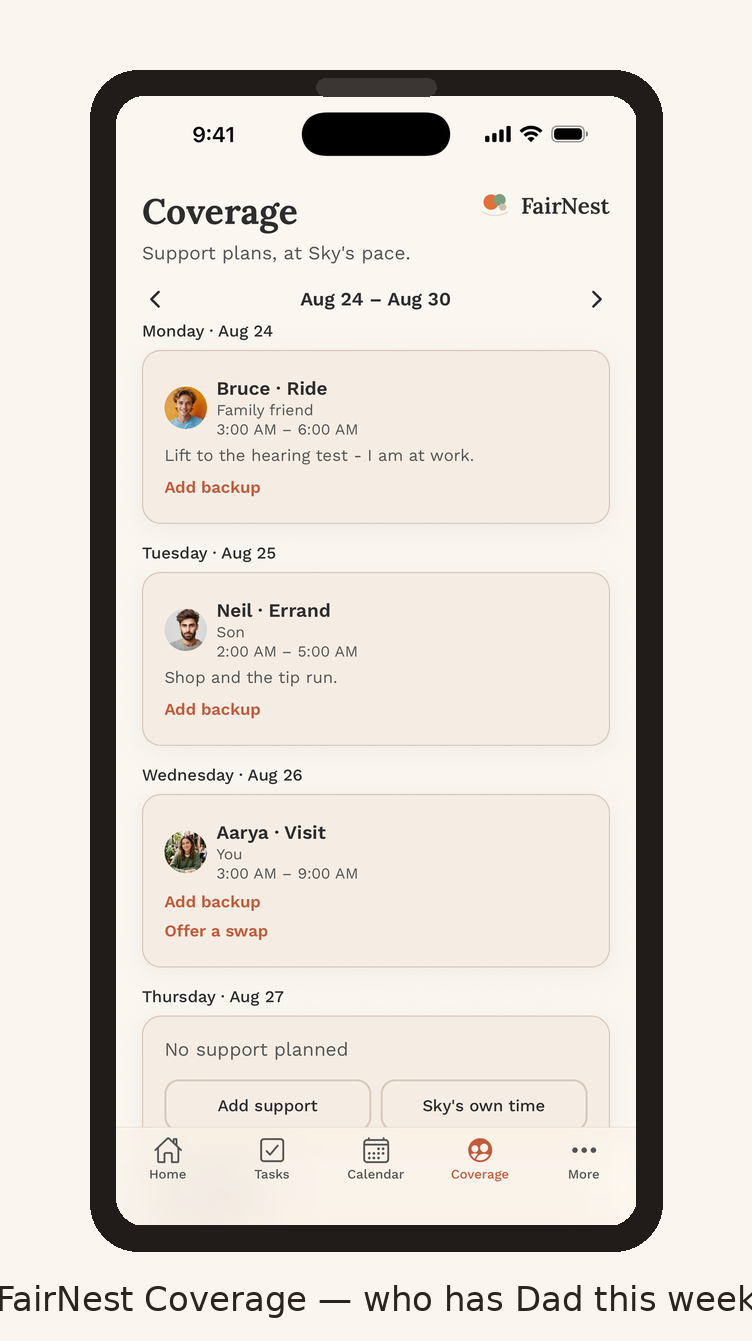
FairNest Coverage — who has Dad this week, so a break is a real handoff, not a hope.
Why I Built FairNest
I built FairNest because I've seen what happens when the whole weight of a parent's care lives in one person's head. One sibling knows the schedule, the meds, the doctor's number — and everyone else just assumes it's handled, because it always is. That's the exact soil resentment grows in: invisible work, done quietly, until the person doing it can't remember the last time anyone asked how they were doing. In our Nest, the week is visible to everyone — who's on, who's off, what needs doing — so asking for a Saturday isn't a confrontation, it's just reading the calendar. It's my own app, built for families like ours. You can find it at getfairnest.com.
You don't have to wait until the resentment turns into something harder — a blowup at the sibling you actually love, or the day you realize you've stopped enjoying your parent's company at all. The feeling showed up for a reason. Name it, trace it to the one unfair thing underneath it, and turn that one thing into one specific ask. That's not selfish. That's how you keep showing up for your parent without quietly disappearing yourself.
Bottom line: Caregiver resentment is a signal, not a verdict on your character. Name it, trace it to the one unfair thing underneath it, and turn that one thing into one specific ask. That's not selfish — that's how you keep showing up for your parent without quietly disappearing yourself.
This post is general information, not medical advice — if the feelings here start to feel heavier, like depression or something you can't shake, your own doctor is the right first call. FairNest is my family caregiving app — one shared Nest for tasks, coverage, handoff notes, cost splitting, and med tracking. Find it free on the App Store at https://apple.co/4xRXJuq and on Google Play at https://play.google.com/store/apps/details?id=com.bizvizorllc.fairnest, and follow along at https://www.instagram.com/fairnestapp/.