

Photo: illustrative — a senior woman and her adult daughter relaxing at home. Stock photo by cottonbro studio via Pexels.
To help aging parents stay in their own home, make a plan before a crisis forces one: make the house safer with small fixes, build a care circle of family and helpers, and put the whole plan — medications, doctors, coverage — in writing where everyone can find it. Staying home is a plan, not luck.
Imagine your mom standing in the kitchen she's cooked in for thirty years, looking you straight in the eye and saying, "I'm not leaving my home." Not angry. Not scared. Just certain. And you get it — her friends are on this street, her garden is out back, every room holds a memory. But you've also noticed the things she hasn't: the throw rug that slides, the stairs she grips a little tighter now, the pill bottles multiplying on the counter. That's the moment most families start asking how to help aging parents stay in their own home — without taking over their life.
Here's the honest truth: staying isn't about stubbornness or luck. It's a plan. And the families who make it work aren't the ones with the most money or time — they're the ones who put the plan together before a crisis forces their hand.
How to Help Aging Parents Stay in Their Own Home: Start With the House
The biggest mistake families make is turning "staying home" into a debate about independence. Your parent hears "you can't manage anymore." What they need to hear is "let's make this house work for you for the next ten years."
So skip the argument and walk the house together, like a guest seeing it for the first time. Look at it the way a fall would: the rug by the front door, the dim hallway to the bathroom, the shower with no grab bar. Most fixes are small and cheap — brighter bulbs, a non-slip mat, a shower chair. A weekend of small changes can buy years of safe independence.
And ask your parent what bothers them about the house, not just what worries you. Maybe the laundry in the basement is the real problem, not the stairs. Fix the thing that actually drains her, and she'll let you fix the rest.
How Do I Build a Care Circle for a Parent Who Wants to Stay Home?
Aging in place doesn't mean doing it alone — it means having people around before the hard week arrives. Sit down with your siblings, a neighbor, a friend from church, whoever's actually in the picture, and talk about who does what.
Keep it specific, not vague. "You take Tuesday evenings, I'll take Saturday mornings, and Mrs. Alvarez next door has a key and checks in on Thursdays" — that helps. Write it down where everyone can see it, because a plan that lives in one person's head falls apart the first time that person gets sick.
Be honest, too, about what the family can't cover. If nobody can be there on weekday afternoons, that's not a failure — it's information. A few hours of paid help a week, a meal service, or rides to appointments can be the thing that makes staying home possible.
Put the Plan in Writing — All of It
Every family has a version of this story: Dad ends up in the ER at 2 a.m., and the sibling who drove him is trying to remember his medications, his doctor's name, and where the insurance card is. The plan was in someone's head — and that someone wasn't there.
So make the folder — the heart of your elder care plan for parents at home — physical or digital — with the medication list, the doctors' numbers, the pharmacy, the insurance card, and who to call first. Update it every few months, like changing the batteries in a smoke detector. A plan you can't find in a crisis isn't a plan.
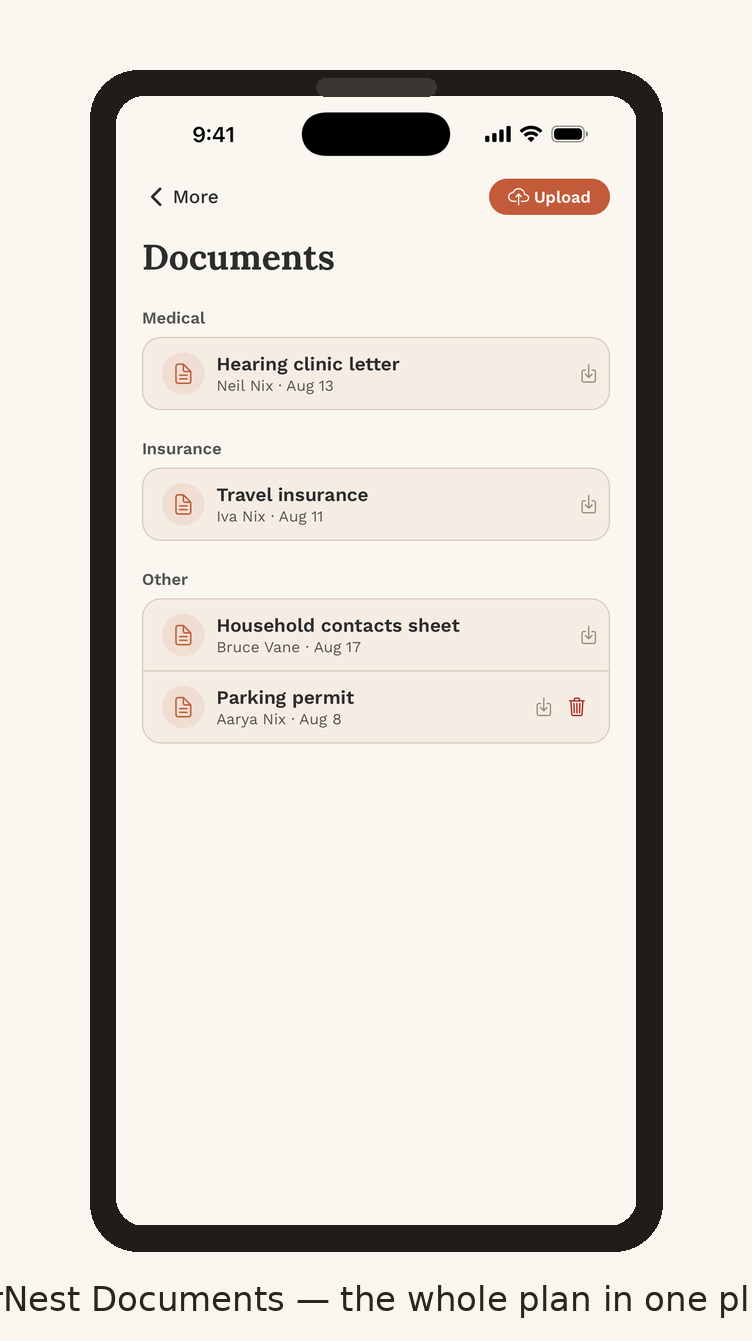
FairNest Documents — the whole plan in one place.
How Do I Get a Parent to Accept Help at Home Without a Fight?
Here's the part nobody warns you about: the hardest part of helping elderly parents stay independent at home is rarely the logistics. It's the pride. To a parent who's spent a lifetime being the helper, accepting help can feel like the first step toward losing everything.
So frame it the way it actually is. A grab bar isn't a hospital fixture — it's a tool, like reading glasses. A home aide a few hours a week isn't a stranger taking over — it's a teammate who makes the good days easier. And your parent staying in charge of the decisions — which help, when, from whom — is the whole point.
If your parent pushes back, don't push harder. Ask what a good week at home looks like to them, and build toward that — people say yes to their own vision far more easily than to someone else's worry.
How Often Should You Update an Aging in Place Plan?
Aging in place isn't a decision you make once. It's an aging in place plan you keep — a home safety checklist for elderly parents that you revisit as things change. The house that worked fine last spring might need a ramp by winter; the Tuesday coverage that worked when your brother lived nearby might need rethinking now that he doesn't. Sit down a few times a year and ask one question: "Is this still working?"
When the answer is yes, celebrate it. When it's starting to be no, you catch it early, while there are still good options on the table. Not perfection — attention.
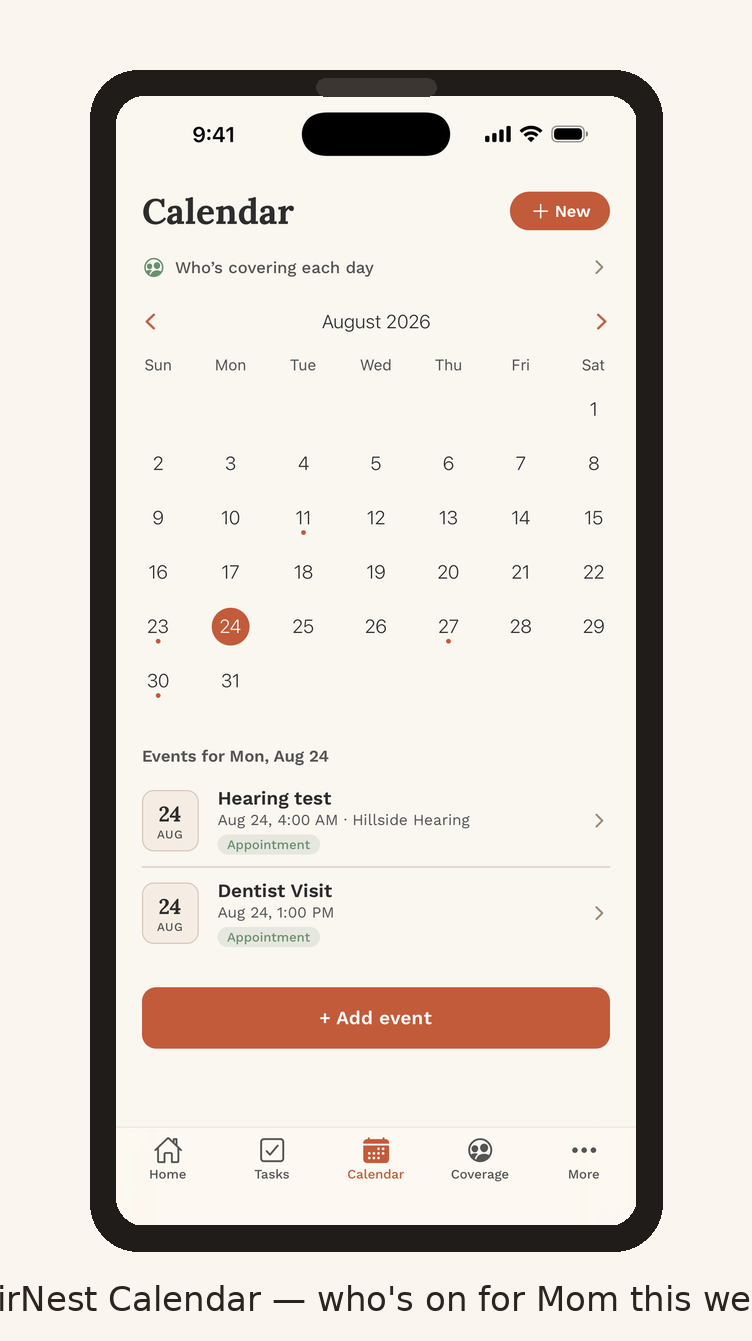
FairNest Calendar — who's on for Mom this week.
Why I Built FairNest
I built FairNest because the plan for keeping a parent at home lives in too many places at once — one sibling's phone, a sticky note on the fridge, a group chat nobody can search. In our Nest, the coverage, the tasks, and the important documents sit in one shared place, so whoever's covering Thursday sees the same plan as whoever's covering Saturday. Nobody has to remember everything, because the family remembers it together.
It's my own app, built for families like ours — the ones who want Mom to stay in the house she loves. You can find it at getfairnest.com.
Your parent's home is more than an address — it's where their life happened, and where they want the next chapter to happen too. The plan that keeps a parent home isn't a single heroic decision. It's a hundred small ones, made early, made together, made in writing.
Bottom line: Helping aging parents stay in their own home comes down to three things: a safer house, a care circle in place before you need it, and a written plan everyone can find. Start small, start early, and revisit the plan every few months — that's how staying home stays possible.
This is general information, not legal or medical advice — talk to your parent's doctor or an elder law attorney about what's right for your family.
FairNest is my family caregiving app — one shared Nest for tasks, coverage, handoff notes, cost splitting, and med tracking. Find it free on the App Store at https://apple.co/4xRXJuq and on Google Play at https://play.google.com/store/apps/details?id=com.bizvizorllc.fairnest, and follow along at https://www.instagram.com/fairnestapp/.