
When should you stop a parent with dementia from driving? Start the conversation as soon as you see a pattern — getting lost on familiar routes, new dents or near-misses, slower reactions — not after a crash. Lead with safety and dignity, bring the doctor in early, and line up rides and alternatives before the keys come off the table, so life keeps moving.
Imagine this: your dad calls you from the grocery store parking lot. He's calm, but he's lost. He drove there fine — he's driven that route a thousand times — but now he can't quite remember how he got there, or which way home is. You talk him through it, turn by turn, and he makes it back. He laughs it off. You don't sleep that night.
If you're wondering when to stop a parent with dementia from driving, that phone call is the moment most families describe. Not a crash. Not a ticket. Just a quiet, unsettling sign that the person behind the wheel isn't quite the driver they used to be — and a question nobody in the family wants to be the one to ask.
So let's talk about how to have it — kindly, early, and before a crisis forces it.
What are the signs a parent with dementia should stop driving?
You don't need a single dramatic incident to start the conversation. Watch for a pattern:
- Getting lost on familiar routes. Once can be a bad day. Twice is a signal.
- New dents, scrapes, or near-misses — especially ones your parent brushes off or can't explain.
- Slower reactions at intersections, trouble judging distance, or confusion at merges.
- Getting flustered by detours or anything that breaks the routine route.
- Other drivers honking more, or passengers feeling nervous riding along.
Any one of these on its own might be nothing. Several together, over weeks, is your answer: it's time to talk. And the earlier you talk, the more choices your parent still gets to make about what comes next — which matters enormously to someone who feels control slipping away in other areas too.
How do I talk to my parent with dementia about giving up driving?
1. Start with what driving means to them, not with what you're taking away. Ask what they love about driving — the independence, the errands, the feeling of still being useful. Listen before you pitch. A parent who feels heard is far more likely to hear you back.
2. Make it about safety, not ability. "I'm worried about the other drivers out there" lands better than "you're not safe anymore." Frame it as a team problem: the roads are faster, the traffic is worse, and you'd feel better if there were a plan. This isn't a trick — it's true, and it preserves their dignity.
3. Bring the doctor into it, early. Many families find the conversation goes better when it isn't just one child versus a parent. A doctor can assess driving fitness, and in many states, doctors can report concerns to the licensing agency. Ask at the next appointment: "Could you talk with Dad about driving?" Let the white coat carry some of the weight. This isn't medical advice — talk to your parent's doctor about what's right for them.
4. Offer a replacement before you remove the keys. Nobody agrees to a void. Line up the alternatives first: a sibling driving schedule, rides from a neighbor, a local senior shuttle, grocery delivery. When your parent can see that life still moves — appointments kept, church on Sunday, lunch with friends — the loss shrinks from "everything" to "one thing."
5. Get the siblings aligned before the conversation, not during it. Nothing undermines this talk faster than one sibling saying "it's time" while another says "Dad's fine." Agree on the plan privately first: who's driving which days, who pays for rides, and what you'll say if your parent pushes back. A united family sounds like care. A divided one sounds like a coup.
What do you do when a parent with dementia refuses to stop driving?
Sometimes, even a gentle conversation ends in a flat no. That's painful, and it's common. A few honest next steps:
- Suggest a professional driving evaluation. It's not a family verdict — it's an independent assessment, and many parents accept a stranger's judgment more easily than a child's.
- Check your state's rules. Some states allow family members to request a re-examination through the DMV, and doctors may be required or permitted to report a diagnosis. Look up the process before you need it, not after an accident.
- Reduce risk in the meantime. Shorter daytime trips, familiar routes only, no highway driving. These are bridges, not permanent solutions — but they buy time while the bigger conversation continues.
Why I built FairNest
I built FairNest, my own app, because the hardest part of moments like this isn't the conversation — it's everything that comes after it. Who's driving Mom to her Tuesday appointment now? Who's covering the grocery run? When one sibling quietly becomes the full-time chauffeur, resentment builds fast, and the parent feels like a burden. FairNest gives your family one shared Nest where rides, tasks, and coverage live in one place, so the driving plan is visible to everyone — not carried in one exhausted person's head.
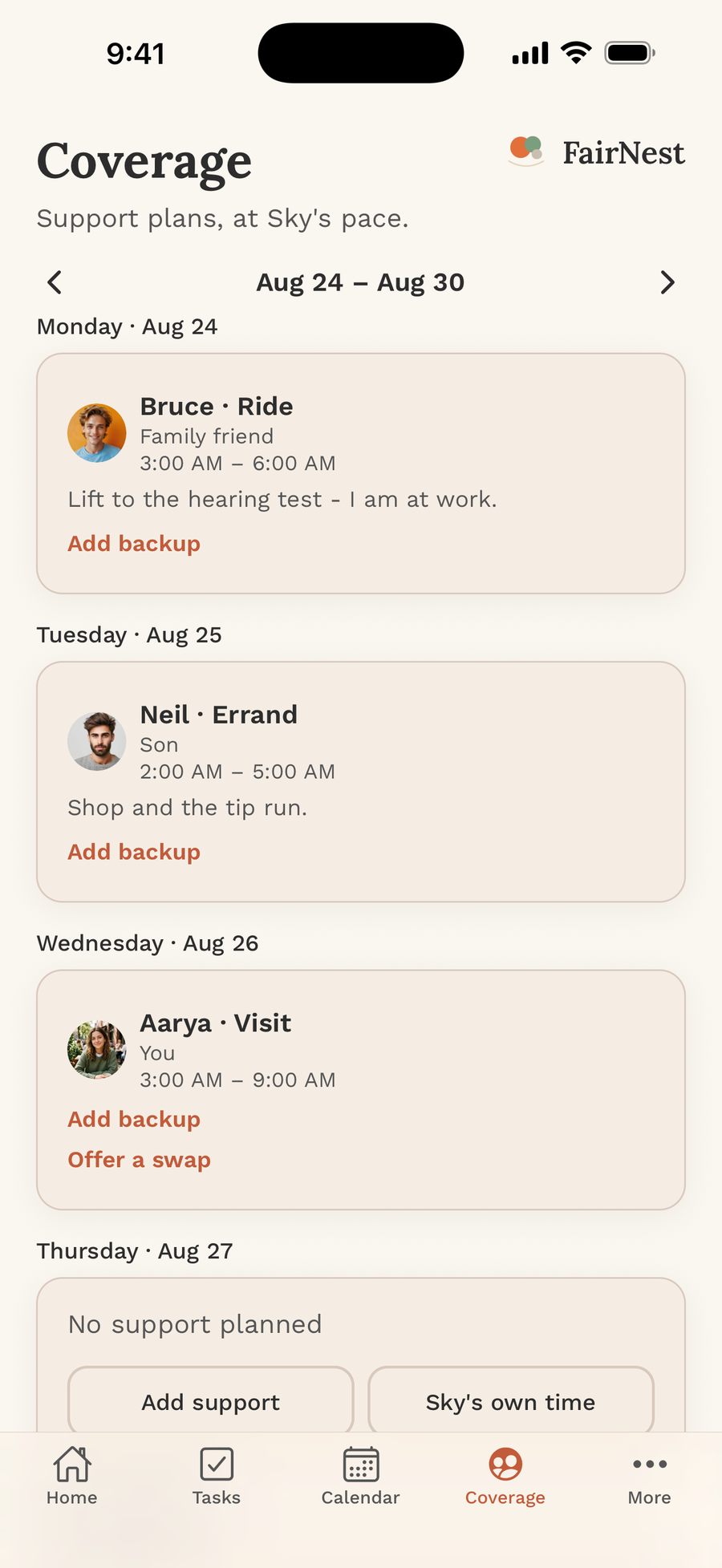
You can learn more at getfairnest.com, and if a shared plan would help your family, it's on the App Store here: https://apple.co/4xRXJuq and on Google Play here: https://play.google.com/store/apps/details?id=com.bizvizorllc.fairnest. We also share daily caregiving ideas over on Instagram at https://www.instagram.com/fairnestapp/.
Bottom line
Bottom line: when to stop a parent with dementia from driving comes down to a pattern, not one bad day — getting lost on familiar routes, unexplained dents, slower reactions. Talk early, frame it around safety, get the doctor and a professional driving evaluation involved, and offer rides before you take the keys. A plan that keeps their life moving is what makes the loss bearable.
The conversation is the care
Stopping a parent with dementia from driving will probably never feel good. But waiting until after a crash feels far worse — and it's the one outcome nobody gets to undo. Having the conversation early, kindly, and with a real plan for what comes next is one of the most loving things you can do. It says: your safety matters more than our comfort, and your life doesn't shrink just because the driving stops.
Start this weekend. Not with an ultimatum — with a question: "How are you feeling about driving these days?" Then listen. The answer will tell you exactly where to go next.