
If a new medication is making your elderly parent confused, drowsy, unsteady, or suddenly anxious, treat it as a possible side effect until proven otherwise. Don't stop the drug on your own — instead, write down what changed and when, call the pharmacist the same day, and bring those dates to the doctor. New medication side effects in an elderly parent are common, often missed, and usually fixable once someone connects the dots.
Imagine this: say your dad starts a new prescription on a Tuesday, and by the weekend something is off. He's groggier than usual at breakfast. He loses the thread of a story halfway through. Or he's suddenly anxious at night when he's always been a sound sleeper. Nothing dramatic enough to call an ambulance — just different enough that you notice, and a timing coincidence worth taking seriously, because this is exactly how new medication side effects in an elderly parent tend to show up.
That feeling is worth trusting. When an older adult starts a new medication and their behavior, sleep, appetite, or balance changes within days or weeks, the new prescription belongs at the top of the suspect list. New medication side effects in an elderly parent are common, often missed, and usually fixable — but only if someone connects the dots and speaks up.
How can you tell if a new medication is causing side effects in an elderly parent?
Here's the tricky part: side effects in older adults rarely announce themselves the way they do in a drug commercial. They don't always look like a rash or nausea. More often they look like aging itself — a little more confusion, a little less appetite, a little more unsteadiness on the stairs. That's exactly why they get missed. The family chalks it up to "just getting older," and the doctor never hears about it because nobody links it to the Tuesday prescription.
So write down what changed, and when. "Started the new blood pressure pill Tuesday. Thursday he skipped lunch, which he never does. Friday he seemed confused about what day it was." Dates matter enormously here, because the single most useful question a doctor or pharmacist can ask is: "When did this start, relative to the new medicine?"
What should I do if a new medication is making my elderly parent confused or drowsy?
1. Don't stop the medication on your own. Every instinct says to just quit the thing that seems to be causing the problem. But stopping some prescriptions suddenly — blood pressure drugs, heart medications, certain mood and sleep medicines — can be riskier than the side effect itself. Unless there's an emergency (trouble breathing, swelling, fainting, a fall with injury), keep giving it and get professional guidance first. If you're worried, call the prescribing doctor's office or the pharmacist the same day.
2. Call the pharmacist, not just the doctor. Pharmacists are often the fastest, most practical source of answers about side effects, and they can usually talk to you the same day without an appointment. They can tell you whether grogginess or appetite loss is a known effect of that drug, whether it tends to fade after a week or two, and whether it interacts with something else your parent takes. Bring the full list — every prescription, every over-the-counter pill, every vitamin.
3. Check for the "new plus old" problem. A new drug doesn't act in isolation. It can amplify the drowsiness of a sleep aid, clash with a pain reliever, or push blood pressure lower than intended when combined with an existing pill. Ask the pharmacist specifically: "Could this new medicine be interacting with anything else on the list?" That one question catches problems a quick glance at a single prescription never will.
4. Track it for a week, in one place everyone can see. Side effects come and go, and memory is a terrible record-keeper when three siblings visit at different times. One shared note — what was observed, on what day, after which dose — turns a vague worry ("he seems off lately") into something a doctor can act on, and stops the classic argument where one sibling says "he's fine" and another says "he's not himself." A shared medication log across the family makes this far easier than scattered texts.
What to tell the doctor
When you get the appointment or the callback, keep it short and factual: the drug name, the start date, the specific changes you've noticed, and when they appeared. "He started amlodipine on the 14th. By the 17th he was napping twice a day and seemed unsteady getting up at night. He never did that before." And don't be shy about asking whether there's a lower dose, a different drug in the same family, or a different time of day to take it.
One more thing worth saying plainly: if your parent brushes it off — "I'm fine, stop fussing" — believe your own eyes anyway. Older adults minimize symptoms because they don't want to be a burden. You're not overreacting. You're doing the job of the person who sees them every day, which no clinician in a fifteen-minute visit can do.
Why I built FairNest
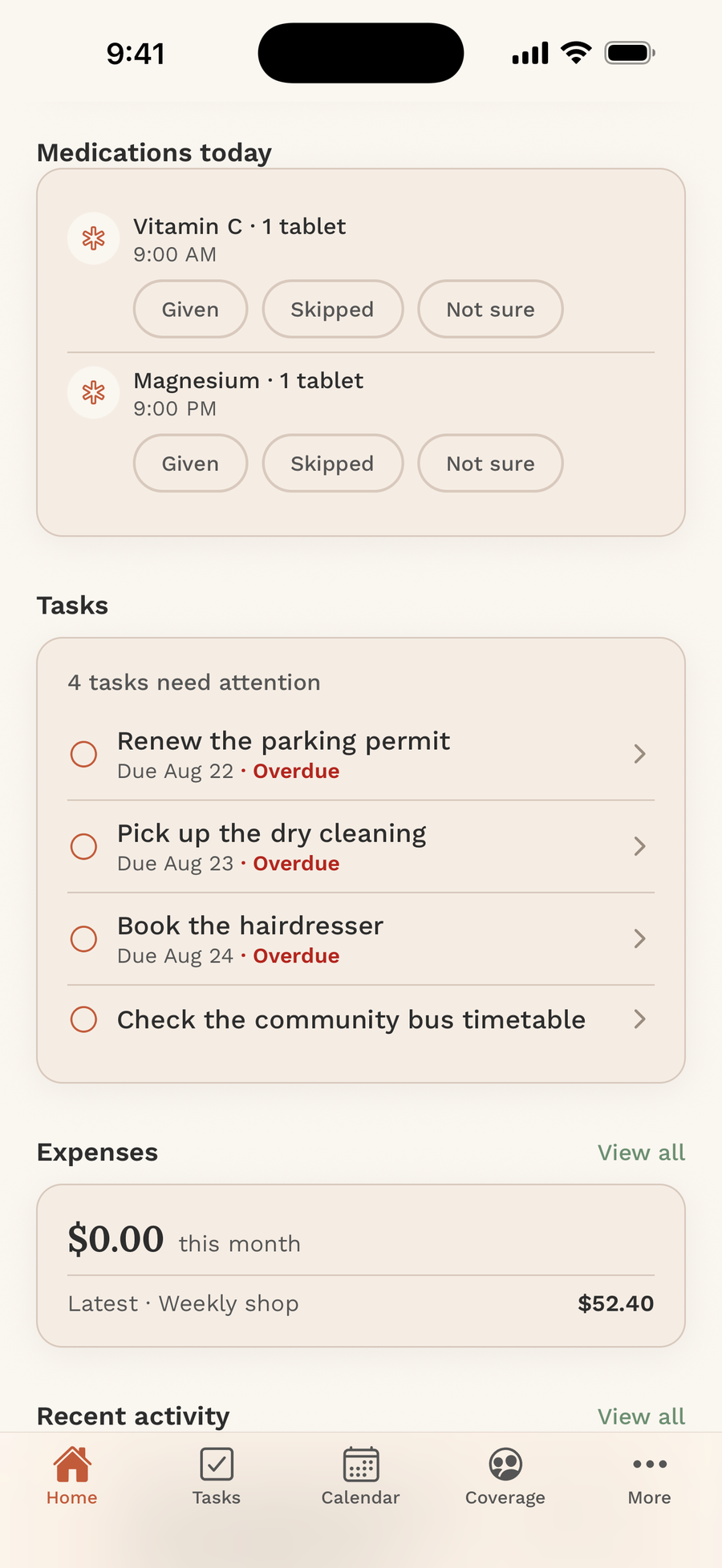
When my own family was coordinating care, the important details — a new prescription, a changed behavior, a pharmacist's answer — lived in five different text threads. That's why I built FairNest, my own app: one shared Nest where the whole family can see tasks, coverage, updates, handoff notes, cost splitting, and med tracking in the same place. You can learn more at getfairnest.com, and find it on the App Store here: https://apple.co/4xRXJuq and on Google Play here: https://play.google.com/store/apps/details?id=com.bizvizorllc.fairnest.
Bottom line
Bottom line: when an older adult starts a new medication and their behavior, sleep, appetite, or balance changes within days, suspect the drug first. Don't stop it on your own — note the dates, call the pharmacist the same day, and bring the timeline to the doctor. Most new medication side effects in an elderly parent are fixable, but only if someone speaks up early.
So if your parent started something new this week and something feels different, don't wait for it to become a crisis, and don't write it off as aging. Write down what you see, call the pharmacist, and bring dates to the doctor. That one habit — noticing early and saying something clearly — is the difference between a side effect fixed in a week and one that quietly reshapes your parent's life for months.
You already noticed. That's the hard part. Now just make sure the right person hears about it.
This isn't medical advice — talk to your parent's doctor or pharmacist about what's right for them.
Follow along on our Instagram for more practical caregiving ideas.