
To recover from caregiver burnout while you can't stop caregiving, start with a protected sleep window, hand off one recurring task permanently instead of asking for temporary cover, rebuild one outside connection, make the invisible work visible so others can see the load, and deliberately lower the bar on what's good enough. Recovery isn't a vacation you can't take — it's getting small pieces of your life back, one at a time, while the caregiving continues.
Imagine this: it's 9 p.m., your parent is finally settled for the night, and instead of feeling relieved, you feel... nothing. Not tired exactly — hollow. You scroll your phone for twenty minutes without absorbing a single thing. You tell yourself you'll rest tomorrow, but tomorrow looks exactly like today. If you've ever typed "how to recover from caregiver burnout" into a search bar, you're not the only one — and you're asking the right question.
Here's the part nobody tells you: recovering from caregiver burnout doesn't start with a vacation you can't take. It starts with getting smaller pieces of your life back, one at a time, while the caregiving continues.
Why doesn't "just take a break" work for caregivers?
Most burnout advice assumes you can step away. But when you're the person your parent calls first — the one who knows the medication schedule, the pharmacy's number, and which days the aide comes — stepping away feels impossible, because in a very real sense, it is. There's no one standing behind you ready to catch everything you drop.
So the standard advice lands like a taunt. A weekend away? Who covers Saturday? The problem isn't that you don't want rest. It's that rest built for people with backup doesn't fit a life without any.
1. Start with sleep, not self-care
Burnout advice loves to start with bubble baths and hobbies. Start with sleep instead — the least glamorous and most powerful lever you have.
You don't need eight perfect hours. You need a protected window: a bedtime, even a late one, with the 30 minutes before it guarded — phone on silent, no care logistics, no "just one more thing." If nighttime caregiving interrupts your sleep, look at whether any of that coverage can move. A sibling taking one overnight a week, or an aide for a single evening shift, changes the whole week. (This isn't medical advice — if exhaustion is affecting your health, talk to your own doctor.)
2. How do I hand off one thing permanently instead of everything temporarily?
Here's a trap: you ask for help in a crisis, someone covers for a weekend, and then everything slides right back.
Instead, pick one recurring task and give it away for good. Not "can you cover Tuesday?" but "can you own the pharmacy refills from now on?" One permanent handoff beats ten temporary ones, because it shrinks the list you carry in your head every single day.
Good candidates: appointment scheduling, grocery runs, bill paying, or managing the aide's schedule. Choose the task that drains you most, not the one that's easiest to explain. And write the handoff down — who owns it and what "done" looks like — so it doesn't quietly drift back to you in three weeks.
3. Rebuild one outside connection
Burnout isolates you. Slowly, without noticing, your world narrows to your parent's house, the pharmacy, and your own kitchen table. Friends stop calling because you always say no. You stop calling because explaining feels exhausting.
Pick one person and one low-effort way back in: a 15-minute walk with a friend, a standing Sunday call with a sibling who isn't in the care rotation, or a caregiver support group where you don't have to explain anything because everyone already knows. You don't need your old social life back all at once — you need proof that a life outside caregiving still exists.
4. Make the invisible work visible
Part of what makes burnout so heavy is that nobody sees the full weight of it. The mental load of caregiving (remembering, tracking, deciding, worrying) is real work, and when it lives entirely in one person's head, it feels endless.
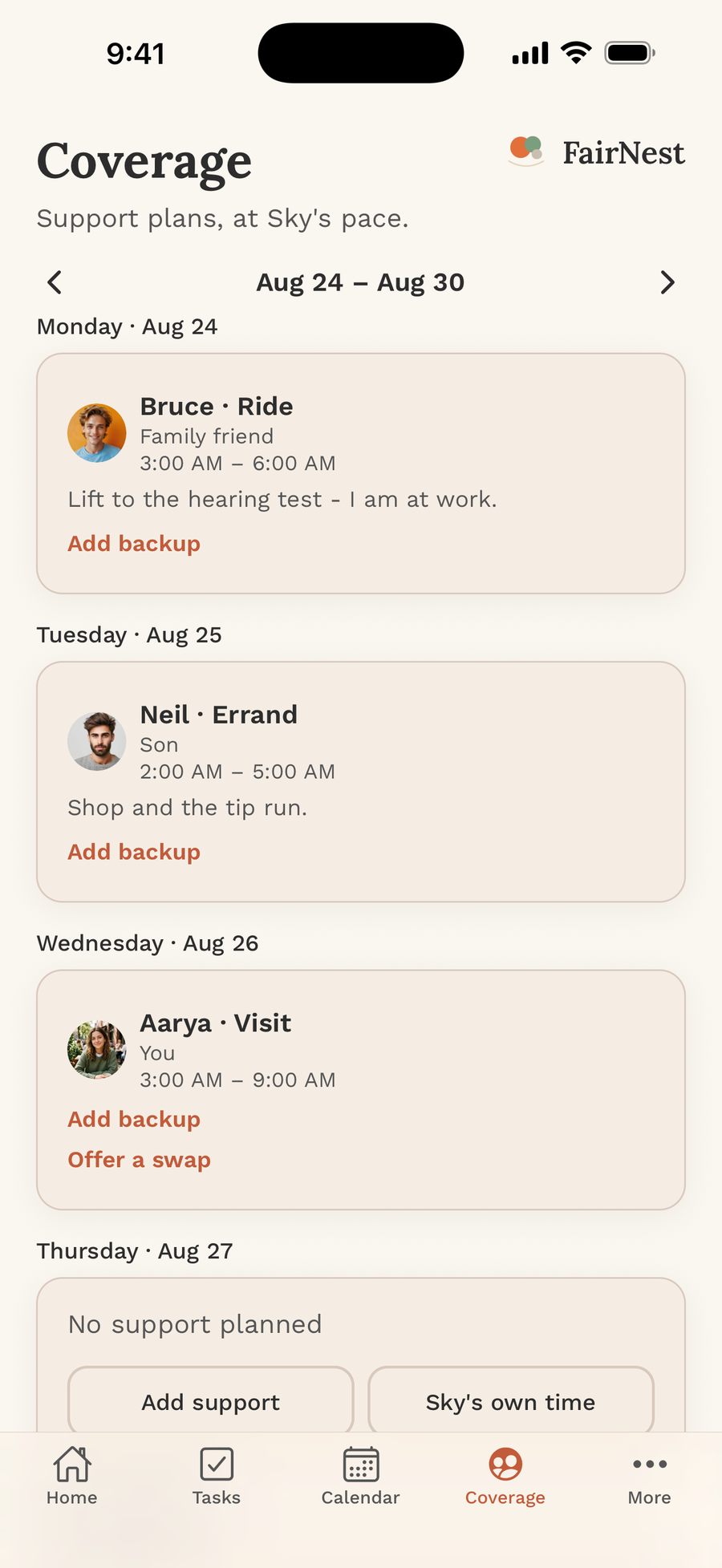
Get it out of your head and somewhere visible: a shared list of tasks, who's covering what, and what's coming up next. It lets other people see the load, and it lets you stop carrying all of it in your mind at 2 a.m. When family can see the whole picture, "I had no idea you were doing all that" turns into actual help.
5. Lower the bar on purpose
Burnout makes everything feel urgent. Recovery means deliberately deciding that some things are allowed to be good enough. The house doesn't need to be spotless. Dinner can be simple three nights a week. This isn't giving up — it's triage, and triage is a skill, not a failure.
Try this: each morning, pick the three things that actually matter today. Everything else is bonus. On a hard day, one thing is enough.
Why I built FairNest
I built FairNest — my own app — because I watched how much of caregiver burnout comes not from the care itself, but from carrying all of it alone and invisibly. When tasks, coverage, handoff notes, and cost splitting live in one shared place — a Nest your whole family can see — the mental load stops living entirely in one person's head. Someone else can pick up a task without you briefing them from scratch. It's not a cure for burnout, but it removes one of its biggest fuel sources: being the only one who knows everything.
If you want to try it, FairNest is free on the App Store: https://apple.co/4xRXJuq and on Google Play: https://play.google.com/store/apps/details?id=com.bizvizorllc.fairnest
What does recovering from caregiver burnout actually look like?
You won't wake up one morning "recovered." Recovery is quieter than that. It's the week you sleep through three nights in a row. It's the Tuesday you realize you haven't thought about the pharmacy all day. It's a friend's laugh on a walk that reminds you you're still a person, not just a caregiver.
Start small: protect your sleep, hand off one thing for good, call one person. That's how you start getting yourself back — while still showing up for the person who needs you.
Bottom line
Caregiver burnout recovery steps are small and stubbornly practical: protect your sleep, hand off one thing for good, call one person, make the load visible, lower the bar. Caregiver exhaustion recovery is quiet — a week of sleeping through the night, a Tuesday without thinking about the pharmacy — and learning how to rest when you're the main caregiver, even a few hours of respite care, is how caregiving lasts years instead of months.
Follow along on Instagram at https://www.instagram.com/fairnestapp/ for more practical caregiving ideas.