
To talk to someone with dementia, step into their world instead of correcting it, say less and slower with one idea at a time, answer the feeling underneath the words instead of the facts, give them more time to respond than feels natural, and redirect warmly instead of arguing. The conversations that work aim at the heart, not the details — because when the facts won't stick, the feelings still do.
Imagine this. You're visiting your mom on a Saturday, and over coffee she tells you, bright and confident, that she's driving to church on Sunday. You know her keys were taken away months ago. Everything in you wants to correct her — gently, the way you'd fix a typo. But you've done that before, and you know how it ends: her smile fades, her voice tightens, and the rest of the visit feels like walking through wet cement.
If you've been searching how to talk to someone with dementia, you're probably standing in that moment right now — loving someone whose memory is rearranging itself, and trying to meet them where they are instead of dragging them back to where they were.
The instinct to correct comes from love. But dementia doesn't respond to correction like a wrong turn. When the facts won't stick, the feelings still do — which is why the conversations that work aim at the heart, not the details.
This isn't medical advice — talk to your parent's doctor about what's right for them.
1. Should I correct someone with dementia — or step into their world?
When your dad insists he has to get to work — retired a decade ago — arguing pulls him into confusion and shame. The middle path is called validation: acknowledge what's real to him right now.
Try: "You really cared about doing good work there, didn't you?" That honors the feeling underneath — identity, purpose, pride — without debating the calendar. It feels strange at first. Then one day you'll watch him relax mid-sentence, and you'll get it: he doesn't need the right answer. He needs to feel heard.
2. Say less, slower, and one thing at a time
A racing sentence with three instructions — "We're going to the doctor at two, so grab your jacket and the insurance card" — asks a brain with dementia to juggle too much at once. When someone can't follow, they often stop trying, or get frustrated.
Break it down. Use their name. "Mom, we're going to the doctor." Pause. "Let's get your jacket." One idea, then wait. It can feel painfully slow. It's also the difference between a morning that works and one that collapses before nine.
3. How do I answer the feeling when the facts are wrong?
"When am I going home?" — said in her own living room — isn't really a question about the address. It's fear. Loneliness. A sense that something is wrong and she wants the version of life where it wasn't.
Correcting the premise ("Mom, you ARE home") lands like a door slamming. Answering the feeling ("You sound like you're missing home. Tell me about it — what do you miss most?") opens one. She gets to visit the memory that comforts her, and you get connection instead of a standoff.
4. Give them more time than you think they need
We finish each other's sentences constantly — it's a sign of closeness in normal conversation. With dementia, it becomes a bulldozer. It signals you're too slow, and the person shuts down rather than be rushed through their own thoughts.
Count to ten in your head after you ask a question. Let the silence sit there, awkward and long. More often than you'd expect, the words arrive — just on a schedule your patience wasn't built for.
5. Redirect instead of arguing — and plan your exits
Some conversations loop: the same anxious question, forty times before lunch. Answering it earnestly every time will exhaust you; getting angry about it will only spike their anxiety and start the loop over.
A warm redirect changes the channel. "That's a good question — before we figure that out, can you help me fold these towels?" Music works, a walk works, a familiar photo album works. You're not tricking them. You're steering the mood, because the mood is what they'll remember — long after the question has dissolved, they'll still carry the feeling your response left behind.
Why I built FairNest
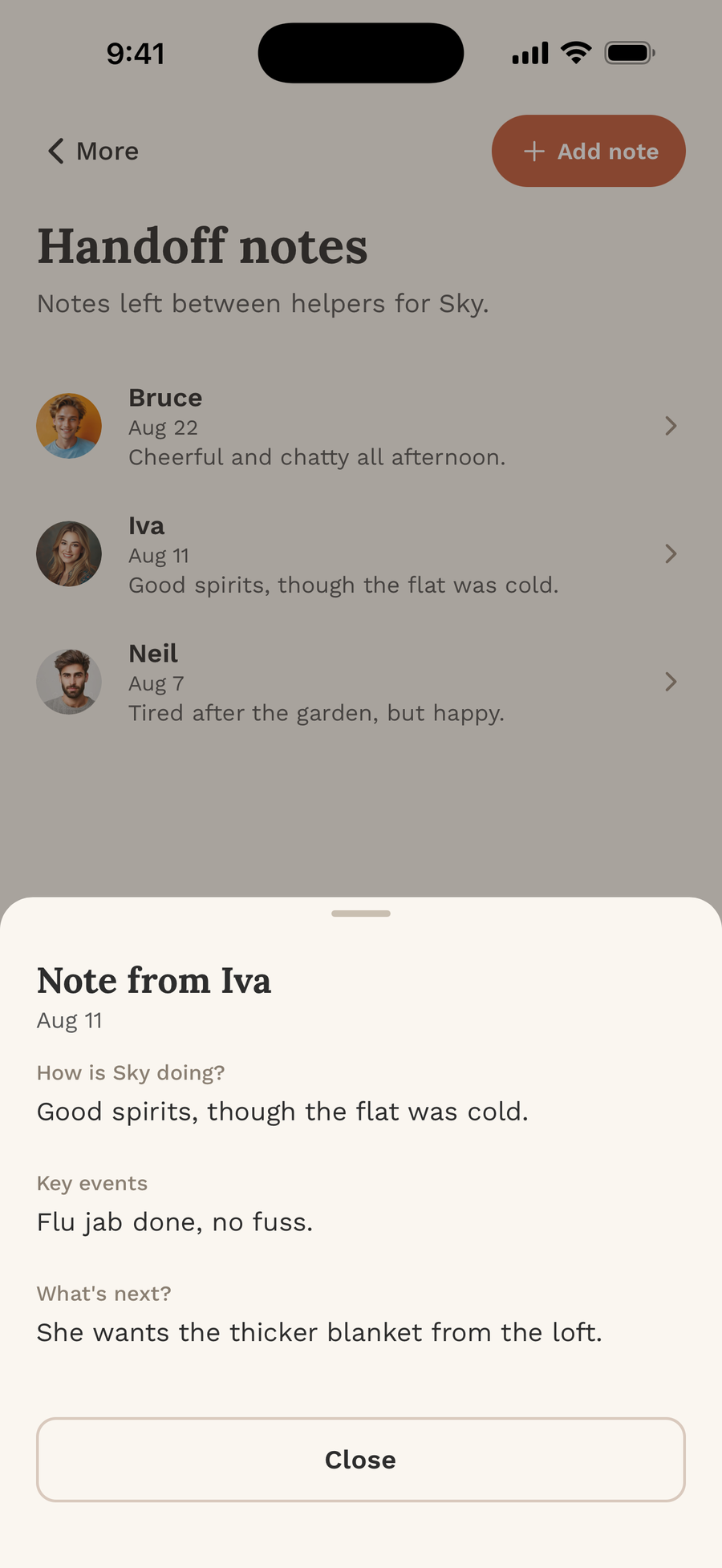
Here's the part nobody warns you about: these rules only work if everyone who interacts with your parent knows them. Your sister visits Saturday, calms Mom beautifully with the photo album trick, and never tells you — so Sunday you stumble into the same loop she solved yesterday.
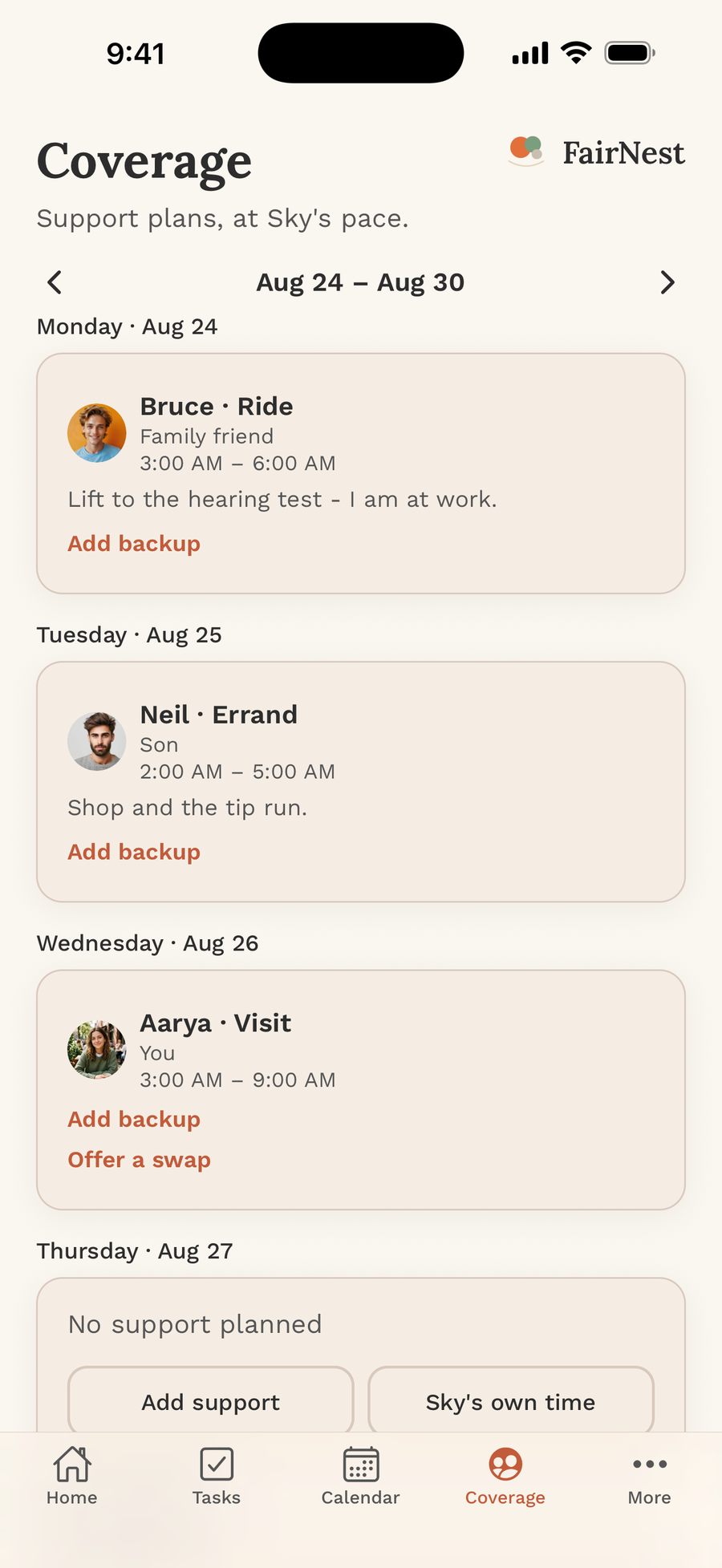
That's why I built FairNest, my own app. The handoff notes are one shared place where the family writes down what actually works with the person they love — the phrases that calm her, the topics to avoid, the hardest hours of the day — so every caregiver starts from the same page instead of rediscovering the same lessons one at a time.
How do I keep going when talking to someone with dementia gets hard?
Learning how to talk to someone with dementia means unlearning a lifetime of habits: being right, being fast, being logical. It will feel wrong before it feels natural. You'll correct them sometimes anyway, and feel terrible, and they'll move on faster than you will.
Give yourself the same grace you're learning to give them. You are speaking to someone who is slowly losing the map while you are learning to read a different one. The fact that you're reading this at all — tired, on a weeknight, searching for the right words — says everything.
They won't remember the exact words you chose. They'll remember how it felt to be with you.
Bottom line
What to say to someone with dementia matters less than how it feels to be with you. The validation technique — honoring what's real to them right now — plus slower speech, more time, and warm redirects are dementia conversation tips your whole family can use, including when your parent asks to go home. You won't get it right every time. The grace you give them, give yourself too.
FairNest is the family caregiving app I built to help families coordinate care — tasks, coverage, handoff notes, cost splitting, and med tracking in one shared Nest. Find it at getfairnest.com, download it free on the App Store or on Google Play, and follow along at @fairnestapp on Instagram.