
To track caregiving expenses for aging parents, use one shared list where every expense is recorded the same day it happens — date, what it was for, amount, and who paid — sort spending into a few honest categories, and settle up once a month against the split your family agreed on. Care costs rarely arrive as one big bill; they arrive as twenty small ones, and tracking elder care costs with siblings on one shared list is what keeps them visible before they become a disagreement.
Say your mom needs groceries on Tuesday, a prescription refill on Thursday, and a grab bar installed on Saturday. You pay for the first two because you're there, your brother covers the grab bar over the phone, and your sister Venmos you for “some of it” on Sunday. Two weeks later nobody can agree on what was spent, who paid, or what's still owed — and you're searching how to track caregiving expenses for aging parents at 10 p.m., not because your family is careless with money, but because care spending happens in small, scattered moments.
That's the real problem. Caregiving costs rarely arrive as one big, tidy bill. They arrive as twenty small ones, paid by different people, in different places. Here's a simple system that makes them visible before they become a disagreement.
How do I track caregiving expenses for my aging parent?
1. Use one shared list — and only one
Pick a single place where every shared expense gets written down, and agree that if it isn't on the list, it doesn't get settled later. The entry needs just four things: date, what it was for, how much, and who paid.
A shared note, a spreadsheet, or an app can all work. What matters is that it's the same list for everyone, updated in the moment — not reconstructed from bank statements and memory a month later. Memory is kind to ourselves and fuzzy about everyone else. A list written the same day doesn't have that problem.
2. Sort spending into a few honest categories
You don't need accounting software. Five buckets cover most families: groceries and household supplies for your parent's home, pharmacy and medical supplies, transport to appointments, paid help (an aide, cleaning, respite), and home fixes and safety items.
Categories help for two reasons. First, you can see where the money is actually going — many families are surprised that transport and small pharmacy runs quietly rival the cost of paid help. Second, when care needs change, you can see which bucket is growing and talk about it early, while it's still a planning conversation and not a crisis.
3. Capture it in five minutes a week, settle once a month
The system only works if it's light. Try this rhythm: whoever pays snaps a photo of the receipt or types the amount into the shared list that day — it takes twenty seconds. Then once a week, someone spends five minutes checking that nothing from the week's appointments or errands was missed.
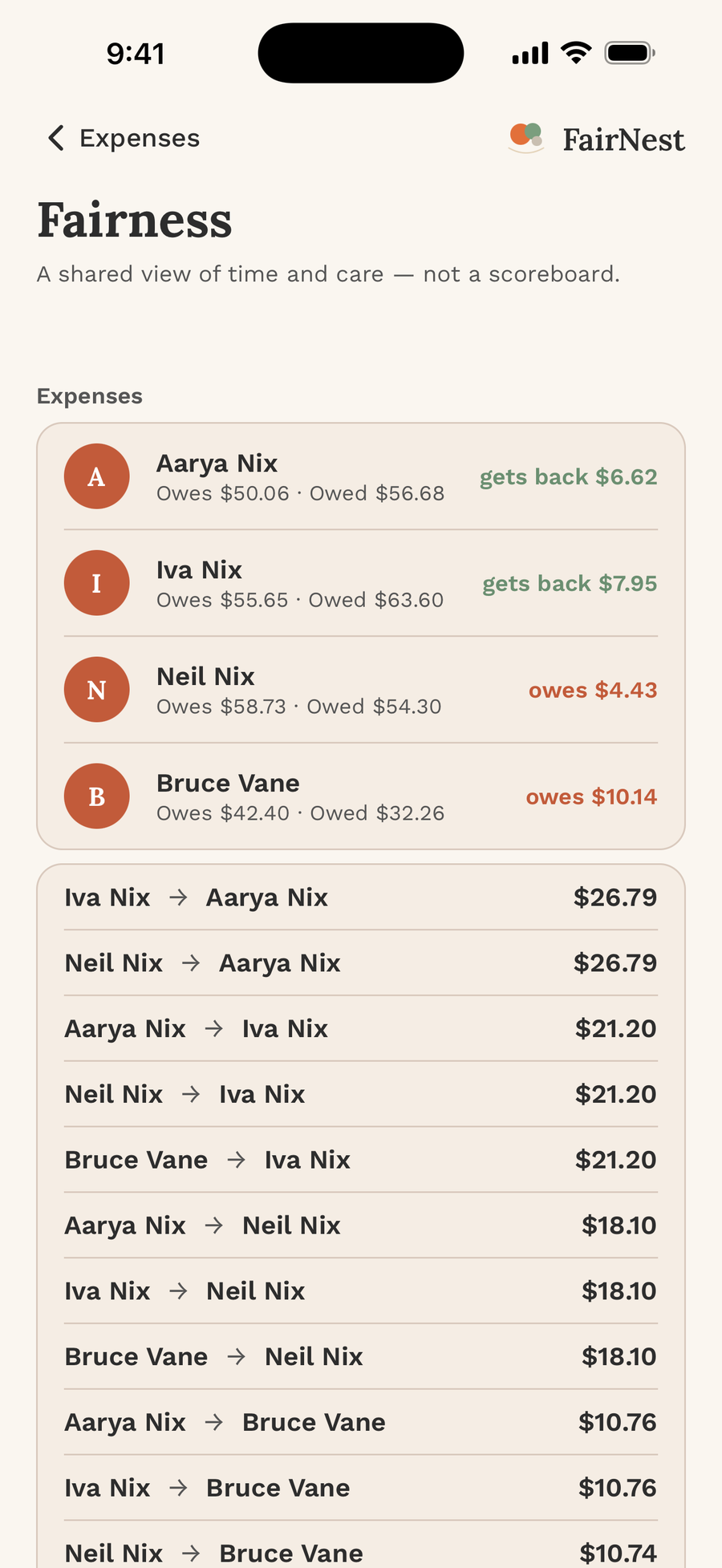
Once a month, settle up. Add up the total, compare it to the split your family already agreed on — equal shares, by capacity, or another arrangement that fits — and even it out in one transfer each, not a tangle of small repayments. Monthly is frequent enough that no balance grows large enough to feel unfair, and short enough that people actually show up for it.
This isn't financial advice — talk to a qualified professional about what's right for your family's situation, especially for anything involving your parent's accounts, benefits, or taxes.
4. Keep a simple monthly total, not just a pile of receipts
Receipts prove a single purchase. A monthly total tells the story. At the end of each month, write down one number: what care cost this month, and the category totals underneath it.
That one habit changes future decisions. If you're weighing whether to add a few hours of paid help, you can compare it to what you're already spending. If a sibling who lives far away asks, honestly, “is it really that much?” — you have a calm, shared answer instead of competing estimates. Keep those monthly totals somewhere safe with other important paperwork, so any sibling can find them.

Why I built FairNest
I built FairNest, my own app, because this scattered-spending pattern kept repeating: one sibling became the default payer, the record lived in texts and a drawer of receipts, and by the time anyone raised it, the conversation was about feeling unseen — not the dollars themselves.
In FairNest, a family shares one Nest for tasks, coverage, updates, and handoff notes, alongside med tracking and cost splitting. An expense sits where everyone can see it, next to the coverage calendar, so time and money are visible together. Your parent can be in the Nest too and see what's going on. You can see how it works at getfairnest.com.
You don't need an app to track well. One shared list, updated the same day, will beat a perfect spreadsheet you rebuild from memory every time. The app just removes the rebuilding.
How do I start tracking care expenses without digging up old receipts?
Don't try to reconstruct the last three months — that archaeology project is why most families never start. Start today. Open one shared list, add this week's care spending, and pick a date at the end of the month to settle up and write down the total.
That's enough. A month from now you'll have something most caregiving families never get: a clear, agreed picture of what care costs — and no one quietly wondering if they're carrying more than their share.
Bottom line
A caregiving expense tracker for the family doesn't have to be fancy — one shared caregiving expense log, updated the same day, categories you can actually read, and a monthly settle-up. Tracking elder care costs with siblings works when the receipts for your parent's care costs and the monthly caregiving cost total live in the same place everyone can see.
FairNest is the family caregiving app I built for exactly this kind of quiet coordination — one Nest for costs, tasks, coverage, and updates. Download FairNest on the App Store or on Google Play, and follow along on Instagram.