
To manage medication refills for elderly parents, keep one shared medication list for your aging parent — every medication with its pharmacy, supply length, and run-out date — start each refill when about seven days of supply are left, give refills one owner and one backup, and do a ten-minute bottle check once a month. Tracking your parent's medications this way is what keeps a Friday-night scramble from happening.
Imagine it's Friday at 6 p.m. and you open your dad's pill organizer for the weekend. One slot is nearly empty — not the vitamin, the important one. The pharmacy closes in an hour, your sister thought you had ordered it, you thought she had, and you're typing how to manage medication refills for elderly parents into your phone while you count the last few pills and do hopeful math.
That scramble is rarely about not caring. It's about refills having no system: each bottle runs out on a different day, nobody owns the calendar, and the first warning is an empty bottle. Here's a calmer way — one list, one owner, and reminders that arrive while there's still time to act.
How do I stop running out of my elderly parent's medications?
1. Start with a refill list, not the bottles in the cabinet
Make one list of every regular medication your parent takes, with the refill facts next to each one: pharmacy name and number, how many days the supply should last, the date it runs out, and whether it needs a new authorization from the doctor or is a straightforward pharmacy refill. Add regular over-the-counter items, too — those run out just as quietly.
Keep that list in one shared place every helper can see. A note on your phone that your siblings can't check isn't a system. One current list is what turns "I think we're low" into a date everyone can plan around.
This isn't medical advice — talk to your parent's doctor or pharmacist about what's right for them, and ask the pharmacist before changing how any medication is ordered or stored.
2. Count backwards from empty, and refill a week early
Don't wait for the last pill. Pick a simple rule: when a bottle has about seven days left, the refill process starts that day. That buffer matters — a pharmacy can be out of stock, a doctor's office may need a day or two to approve something, or a holiday closes everything.
Write the "order by" date on your list, not just the "runs out" date. The runs-out date is the emergency; the order-by date is the plan. If a medication is running out faster than it should, note it and ask the pharmacist or doctor — the count itself can be useful information.
3. Give refills one owner, one backup, and fewer pharmacies if you can
Refills fail the same way other care jobs do: everyone assumes someone else did it. So name one person who owns refills — watching the dates, ordering, and confirming the medication is actually in the house — and a backup for vacations and busy weeks. Owning refills doesn't mean that person pays for everything or does every pickup; it means the job doesn't belong to nobody.
Also ask the pharmacist whether refill dates can be lined up so more medications come due around the same time, or whether reminder or automatic refill options are available. Not every medication or plan allows the same options, which is why it's a question for the pharmacy, not an assumption. Fewer due dates means fewer chances for one bottle to slip through.
4. Do a ten-minute bottle check once a month
Once a month, sit down with the bottles, the refill list, and the calendar. Count what's actually left. Check that no medication on the list has been stopped by a doctor but is still sitting in the daily routine, and that nothing new from a recent appointment is missing from the list. Look at the next month and ask: what runs out, when do we need to order it, and is anyone traveling when a pickup is due?
This short check is also the moment to update the list after any appointment or hospital visit, when doses change most often. Write the change, the date, and who heard it, the same day. A refill system is only as good as the list underneath it — if the list is stale, you'll refill the wrong thing very efficiently.
Why I built FairNest
I built FairNest, my own app, because this scramble kept showing up in different forms: the knowledge lived in one person's head, the reminder lived in nobody's calendar, and the family found out only when it was already urgent.
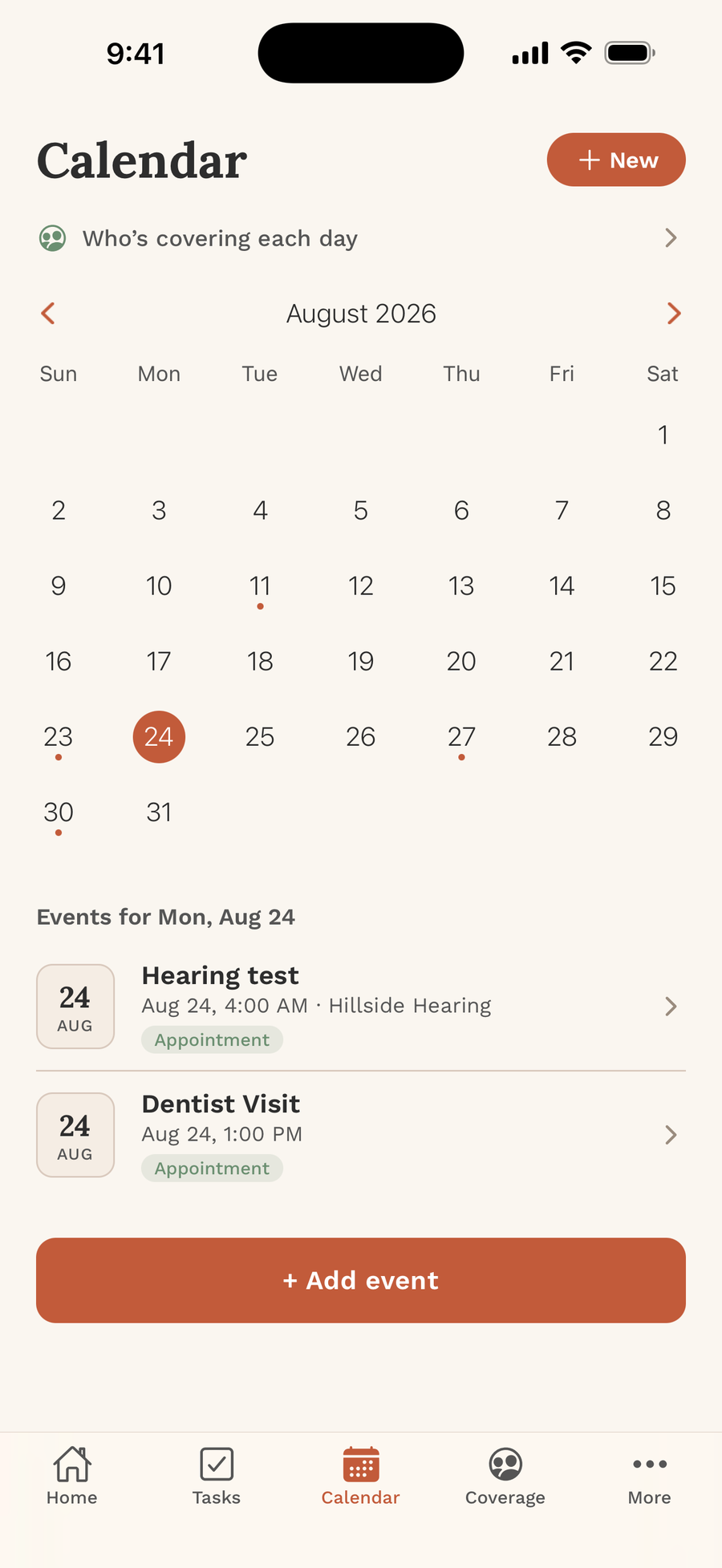
In FairNest, a family shares one Nest for tasks, coverage, updates, and handoff notes, alongside med tracking and cost splitting. A refill can sit there as a dated task with a name on it, a dose can be marked Given or Skipped as it happens, and your parent can be in the Nest too. You can see how it works at getfairnest.com.
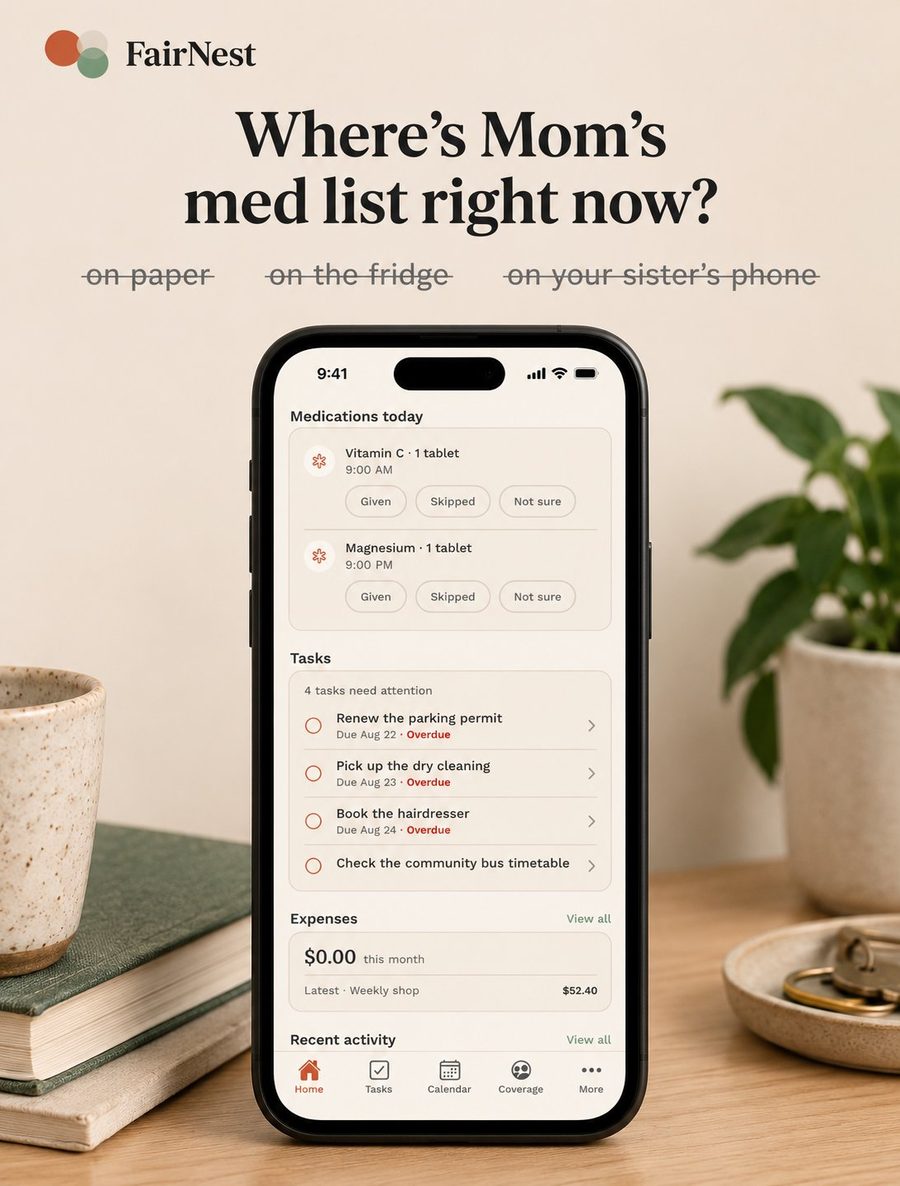
You don't need an app to do any of this. A paper calendar and one shared list will beat an empty bottle every time. The app just makes the dates and the owner visible to everyone, so the reminder doesn't depend on one exhausted person's memory.
What can I do this week, before the next empty bottle?
Pick one evening this week and build the refill list: every medication, the pharmacy, the runs-out date, and the order-by date a week before it. Put one name next to refills, and one backup name underneath.
That's it. No scramble, no hopeful pill-counting on a Friday night — just a boring, early reminder and a family that already knows whose job it is. Boring is exactly what you want medication refills to be.
Bottom line
An elderly parent prescription refill system doesn't need to be complicated — one shared medication list for your aging parent, refills started a week early, one owner and one backup, and a ten-minute bottle check each month. Set a pharmacy refill schedule everyone can see, and the refill reminders for your parent's prescriptions stop depending on one person's memory.
FairNest is the family caregiving app I built for exactly this kind of quiet coordination — one Nest for medications, tasks, coverage, and updates. Download FairNest on the App Store or on Google Play, and follow along on Instagram.