
You can't take a break from caregiving if every answer lives only in your head — a Saturday off becomes caregiving by text from a different chair. The fix is making yourself replaceable for a day: write down how the day actually runs, hand over coverage instead of tasks, and let the first imperfect handover happen anyway.
Imagine a friend finally talks you into taking a Saturday off. Not a vacation, just a Saturday — lunch out, phone in your pocket, no errands. You say yes. Then your phone starts buzzing.
Where does Mom keep her afternoon pills? Did she already take them? She won't eat the soup, what else does she like?
By the third message you're not really at lunch anymore. You're caregiving by text from a different chair.
If that sounds familiar, here's the truth I wish someone had told me sooner: a lot of caregiver exhaustion isn't about the hours. It's about being the only copy of the instructions. You can't rest — really rest — if everything your parent needs lives only in your head.
Why can't I rest even when I take time off?
Most caregiving tasks are visible. Driving to appointments. Cooking. Sorting pills. But underneath them sits a second, invisible job: remembering.
You remember which pill gets cut in half. Which neighbor has a spare key. That Dad takes his medicine in applesauce but not in water. That the insurance card is in the blue folder, not the gray one. Nobody assigned you this job, and nobody can take a shift at it, because you can't hand someone a memory.
That's why "just take a break" so often fails. A break that routes every question back to you isn't a break. It's remote work. The fix isn't a longer break. It's making yourself replaceable for a day — on purpose, and without guilt.
1. Write down the day the way it actually runs
Not a medical file. Not a perfect manual. Just one page that answers: what does a normal day look like, start to finish?
Wake time and morning routine. Meals that actually get eaten. Medicines and when they're taken, in one list everyone uses. The walk, the show, the nap. The small things that prevent a hard afternoon: the sweater for when she's cold by 4 p.m., the call that settles her in the evening.
Keep it short enough that a sibling would actually read it. One honest page beats a binder nobody opens.
This isn't medical advice — talk to your parent's doctor or pharmacist about what's right for them, and keep their official medication list as the source of truth.
2. Put the "in case of" answers where someone else can find them
Breaks fall apart on surprises, not the routine. So answer the surprise questions in advance, in writing:
Who do we call first if something seems wrong — and who's the backup? Where are the insurance cards, the medication list, the spare key, the doctor's number? What can wait until tomorrow, and what can't?
You don't need to plan for everything — just the five things most likely to send your phone buzzing while you're trying to eat lunch in peace.
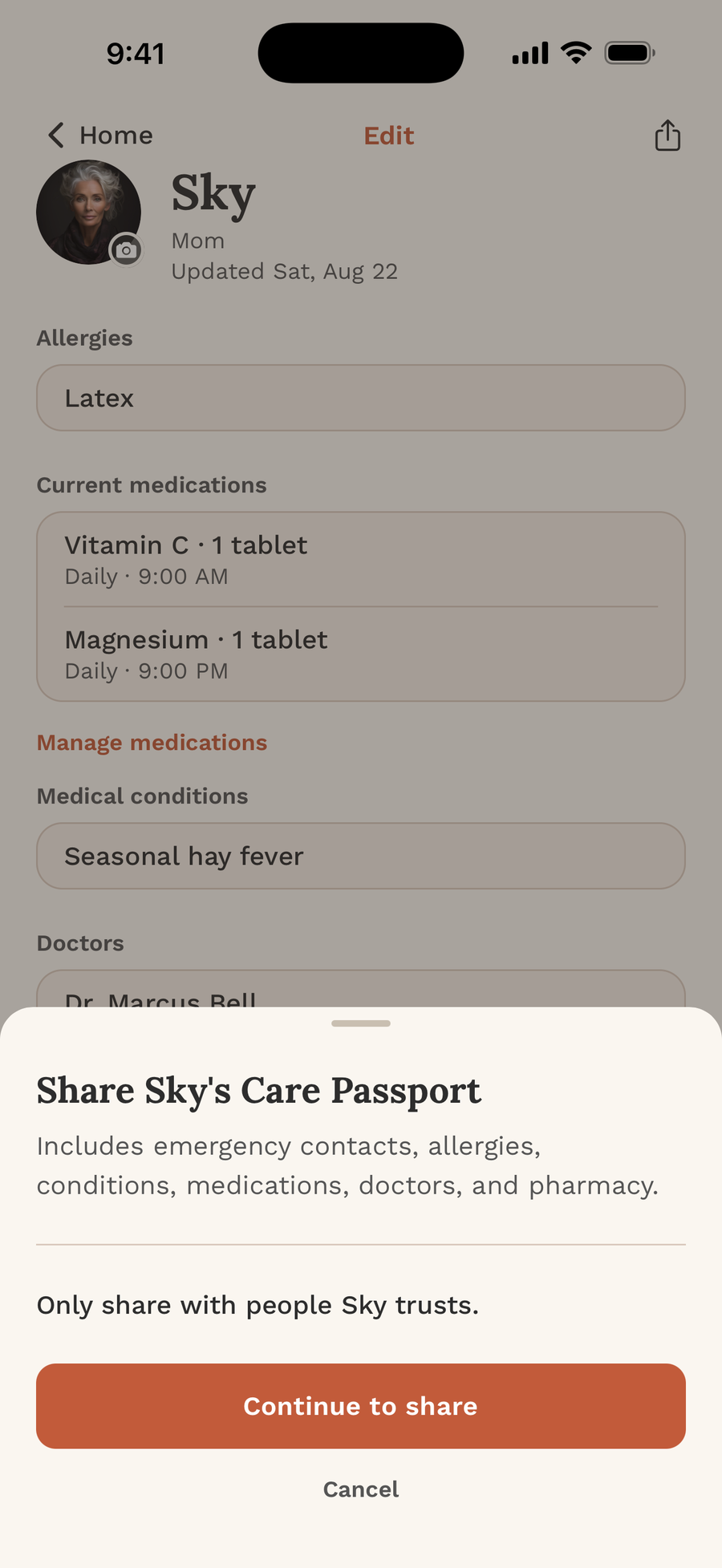
3. Hand over coverage, not just tasks
There's a difference between "can someone pick up the prescription?" and "you're on coverage Saturday from 10 to 4 — questions go to you first."
When you ask for a task, you stay in charge; you're just delegating chores. When you hand over coverage, you actually get to leave. Name the person, name the hours, and agree they'll make the small calls themselves — and only reach you for a real emergency.
Say it out loud, kindly: "If it's not urgent, let's sort it out when I'm back." Then let it be true. If you answer every small question anyway, nobody learns they can handle it — including you.
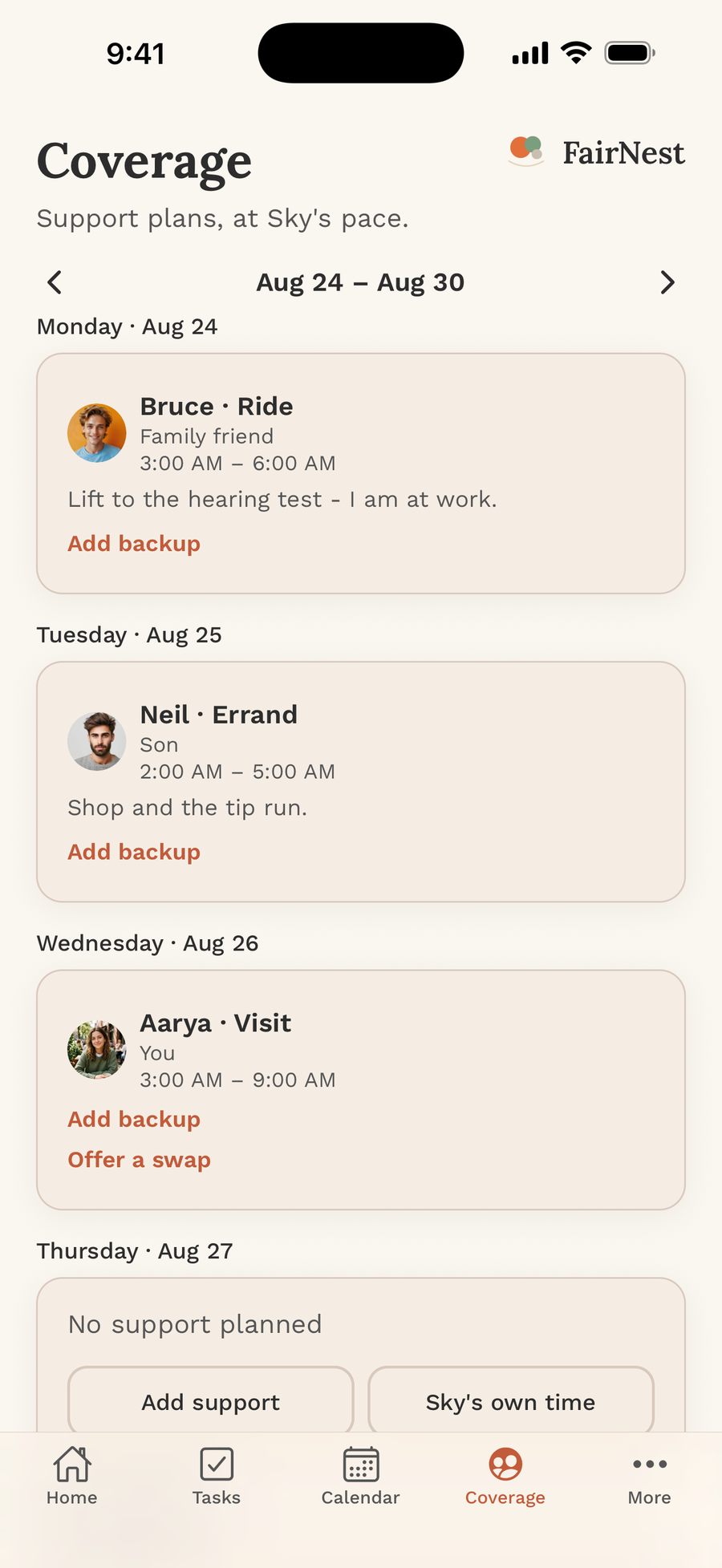
4. What if the first handover goes imperfectly?
The first time someone else covers, something will be done differently. Lunch will be later. The "wrong" mug will be used. A note will be missed.
Different is not the same as unsafe. If you hold your break hostage to everything being done exactly your way, you will never take one — and resentment builds on both sides. Let your covering sibling or friend leave notes about what happened, read them when you're back, and adjust the one-page guide. Each handover gets easier because the knowledge is finally shared instead of trapped.
That's honestly why I built FairNest — my own app. I kept seeing one person carry the whole mental map of a parent's care, too burned out to rest and too essential to leave. In FairNest, the shared Nest holds the tasks, coverage, handoff notes, and med tracking in one place, so a Saturday off doesn't depend on you answering texts from the passenger seat. You'll find it at getfairnest.com.
5. Start smaller than a vacation
Don't start with a week away. Start with three protected hours and a person you mostly trust. Debrief for five minutes afterward: what did they need that wasn't written down? Add it. Then do it again in two weeks, a little longer.
Rest you can repeat beats rest you dream about. And every repetition teaches your family: this care belongs to all of you, not just the person who remembered everything first.
Bottom line
Bottom line: you can't rest if you're the only copy of the instructions. Write down how the day runs, hand over coverage — not just tasks — and take the break even if the first handover is imperfect. Making yourself replaceable for a day isn't stepping away from your parent; it's how their care survives the day you get sick or worn down to nothing.
You are not abandoning anyone by being replaceable
Making yourself replaceable for a day isn't stepping away from your parent. It's how you make sure their care doesn't collapse the day you get sick, stuck at work, or simply worn down to nothing.
Write the page. Name the coverage. Take the Saturday.
If your family is carrying care the way so many of us do — one exhausted person holding the whole map — FairNest is the shared Nest I built to spread that map around: tasks, coverage, updates, and handoff notes in one place. You can get it here: https://apple.co/4xRXJuq or on Google Play at https://play.google.com/store/apps/details?id=com.bizvizorllc.fairnest
And if this one landed, I share more everyday caregiving notes on Instagram at https://www.instagram.com/fairnestapp/ — the small, practical things that make this work more shareable.