
Repetitive questions in dementia usually aren't about the information — they're about worry. Short-term memory frays first, so the same question comes back because the answer never settled the feeling underneath. Answer the feeling first, in the same short sentence every time, and write the answer where your parent can find it without you.
Say your dad asks, at 9:10, what time his appointment is. You tell him: Thursday, 10:30, Dr. Patel. At 9:22 he asks again. Same words, same worried tone, like the first conversation never happened. At 9:40 he asks a third time — only now he's also wondering if he's already missed it.
By lunch, you have answered the same question forty times, or it just feels that way. And somewhere around answer twelve, you hear a sharpness creep into your own voice that you hate. Then comes the guilt, because he isn't doing this to annoy you. He genuinely doesn't remember asking.
If you're living some version of this, you are not failing at patience. Repetitive questions are one of the most common — and most quietly exhausting — parts of dementia care. A few small changes can lower the number of repeats, and make the ones that still come easier to answer.
Why does my parent with dementia keep asking the same question?
It helps to know what's actually happening. In many forms of dementia, short-term memory is the first thing to fray, so a new answer doesn't stick long enough to settle the worry. The question isn't really about information, either. "What time is my appointment?" often means "Am I safe? Is someone keeping track? Am I going to be left alone with this?"
That's why logic rarely ends the loop. You're answering the words. He's asking about the feeling underneath. When you answer the feeling first, the loop often loosens.
This isn't medical advice — talk to your parent's doctor about what's right for them, especially if repetition suddenly gets much worse, which can sometimes signal pain, infection, or a medication issue.
1. Answer the feeling, then the fact — in the same short sentence
Try keeping your answer brief, calm, and nearly identical each time: "You're safe, Dad. I'm keeping track. Thursday, 10:30, and I'll drive you."
Same phrasing matters. Novel explanations give a struggling memory more to hold onto and lose. A familiar sentence becomes a kind of handrail — he may not remember the details, but the sound of the answer starts to feel known. Resist adding new details mid-loop ("and remember, we need labs first, and parking is..."). Save extras for a calmer moment.
2. Write the answer where he can find it without you
A lot of repetition is a search for reassurance when you're in another room. Put the answer in the environment instead of only in your voice.
A simple whiteboard or large note where he looks most — by his chair, on the fridge — might say: "Today is Friday. No appointment today. Appointment: Thursday 10:30. Sarah is here at 4." Update it each morning, and point to it gently: "Let's check your board together."
It won't eliminate questions, but on many days it gives him a way to settle himself — and gives you a break from being the only source of truth.
3. Make the day predictable enough to borrow calm from
Anxiety grows in blank spaces. A loose, visible routine — breakfast, walk, lunch, rest, a favorite show — gives the day a shape he can feel even when he can't recall it. You don't need a minute-by-minute schedule. You need anchors, in the same order, at roughly the same times.
When a question spikes, connect it to an anchor: "Lunch is next, then your show. The appointment is after tomorrow's breakfast." Sequences can be easier to trust than clock times alone.
4. Make sure everyone answers the same way
Here's the part families miss: if you say "Thursday 10:30, I'm driving you," your sister says "Don't worry about it," and a neighbor says "I think it's Friday?" — your dad now has three different answers, and the anxiety that drives the questions gets worse.
Agree on one short family answer and share what actually works. Which phrase calmed him? Did the whiteboard help today? Did music after lunch settle the late-afternoon loop?
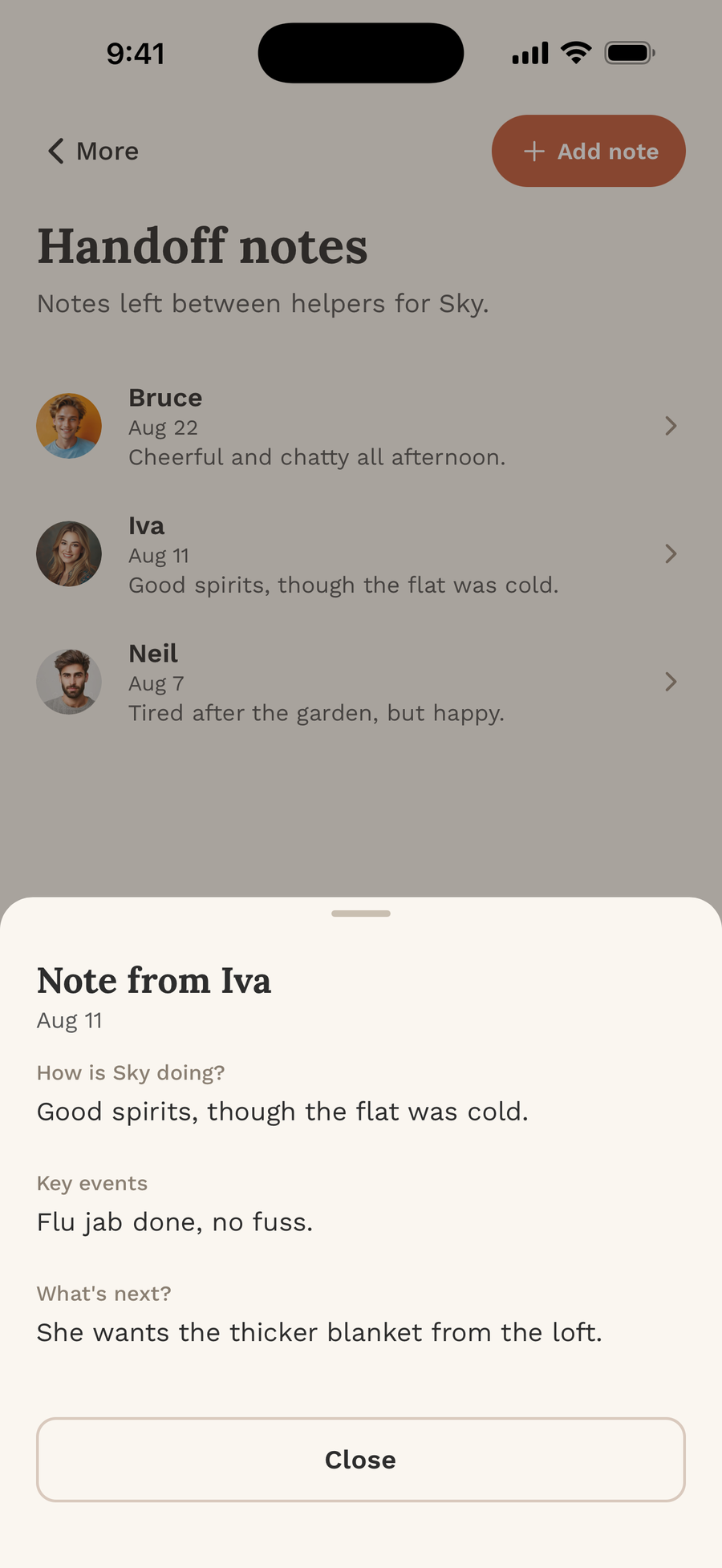
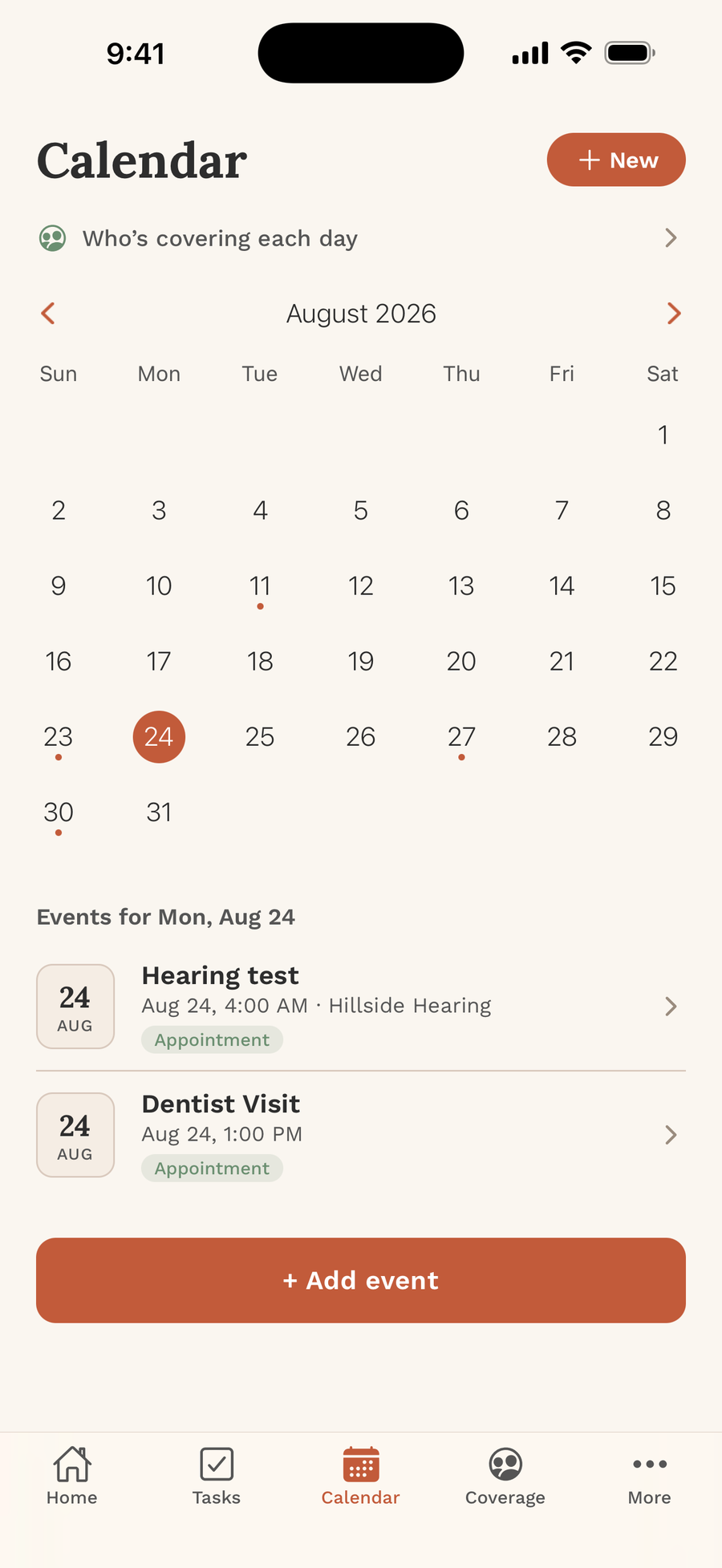
That's why I built FairNest — my own app — with handoff notes at the center of the shared Nest. I kept watching families rediscover the same calming trick shift after shift because nobody wrote it down. In FairNest, the note "the board by his chair works, use the Thursday sentence" sits alongside tasks, coverage, and med tracking, so everyone answers from the same page.
5. How do I cope when I lose patience answering the same question?
You will still lose your patience sometimes. That doesn't make you a bad son or daughter; it makes you a person answering the same worried question on very little sleep.
Build tiny resets into the loop itself: after you answer, step onto the porch for sixty seconds. Trade off with a sibling for the high-repetition hours if you can, even by phone — a fresh voice often resets both of you. If questions cluster at a certain time, like late afternoon, plan support for that window instead of white-knuckling it alone.
And when you do snap, repair is allowed. "I'm sorry I sounded sharp — I'm not upset with you" matters. You don't have to be perfect to be trustworthy.
Bottom line
Bottom line: repetitive questions in dementia are usually a search for reassurance, not information — so answer the feeling first, in the same short sentence every time. Put the answer where your parent can find it, make sure everyone gives the same answer, and measure success by whether he settled faster, not whether he stopped asking.
A gentler way to count the day
You probably won't stop the question from coming back. Dementia doesn't work that way, and measuring success by "he stopped asking" will break your heart.
Measure it differently: Did he settle faster? Did the board help once? Did everyone give the same answer? Those are real wins.
If your family is navigating this stage, FairNest is the shared Nest I built for exactly these days — tasks, coverage, updates, and handoff notes in one place, so the answer that works doesn't live with just one exhausted person. You can get it here: https://apple.co/4xRXJuq or on Google Play at https://play.google.com/store/apps/details?id=com.bizvizorllc.fairnest
I share more of these everyday caregiving guides on Instagram at https://www.instagram.com/fairnestapp/ — especially the small tricks families tell me actually helped.