
Coordinating caregiving with siblings gets easier with one 15-minute weekly sync: five questions, same time each week, answers written down where everyone can see them. It replaces the 63-message group-chat scramble with a simple family care plan everyone actually follows — and it takes less time than scrolling back to find the one message that mattered.
Sunday night. The family group chat has 63 unread messages and your heart sinks a little when you open it. Somewhere between your sister's thumbs-up emoji, your brother's "wait which pharmacy?", and a photo of the pill organizer someone loaded on Friday, there's an actual question that needs answering — and you cannot find it.
Here's the real problem with the group chat as a care plan: it mixes everything. Urgent updates, grocery lists, logistics, and six variations of "ok" all swim in the same stream. Anything important gets buried. Nobody can remember what was decided, so everyone re-decides it — or worse, assumes someone else is handling it.
The fix isn't another app bolted onto your life. It's a rhythm. Fifteen minutes, same time each week, same questions, every time. I call it the Sunday Sync, and families that adopt it tell me it's the single biggest reducer of caregiving friction they've tried — bigger than any new pill organizer or schedule.
Why does a 15-minute sync beat 63 group-chat messages?
A group chat is asynchronous chaos: messages arrive at midnight and get read at 7 a.m., half-remembered, replied to with a reaction emoji that means everything and nothing. A sync is different. It's synchronous, bounded, and — most importantly — it has an agenda. Five questions, every week, no improvisation.
The agenda matters more than the platform. You can do the Sunday Sync as a phone call, a video call, or even an async thread — but run it like a meeting with a beginning, a middle, and an end, because that's what it is.
The five questions
1. What changed this week? Medication changes, new symptoms, doctor visits, moods, appetite, sleep. Keep it factual and brief — "Dad's blood pressure has been running high in the mornings; doctor said to keep tracking" — not a forty-minute retelling of the appointment. If someone wasn't there, write it down somewhere everyone can find it later. Memory is not a filing system.
2. What's coming this week? Appointments, visitors, prescription refills, bills due. The point is visibility: every person on the call should leave knowing what the week holds. This is where you catch the collision — "wait, I have a work trip Thursday" — while there's still time to fix it, instead of discovering it in a panicked group-chat exchange on Wednesday night.
3. Who's covering what? This is the load question, and it's the one families avoid most. Go day by day: who has Monday morning? Who's the backup if the aide cancels? Be specific. Vague coverage ("I'll be around") is how things fall through the cracks. Specific coverage ("I have Tuesday and Thursday afternoons, backup is Marcus") is how things don't.
4. What's one thing we need to decide? Families let decisions rot in the group chat for weeks — the ramp quote, the follow-up appointment, the housekeeping service. Pick one per week. Name the decision, the deadline, and the owner. A decision without an owner is just a topic. You'll be amazed how fast the backlog clears when you cap it at one a week.
5. Who needs a break? Say it plainly. The local sibling who's been at the house five days running might need someone to take the weekend. The far-away sibling might need a week of not being the one who calls the pharmacy. Naming it out loud takes the guilt out of it. Rest is a logistics problem, not a character flaw.
How do you make a weekly family sync stick?
A ritual only works if it's easy to repeat. Pick a time and protect it: Sunday at 7 p.m., say, or Monday morning if weekends are chaos. Keep it to fifteen minutes — set a timer if you have to. The family that tries to make it an hour will skip it; the family that keeps it to fifteen will still be doing it in six months.
Rotate who runs it. The local sibling usually ends up running everything; rotating the facilitator is a small act of fairness that pays out in goodwill. And always end with one sentence: "Okay, so this week it's…" — one line that summarizes who covers what, said out loud. That single sentence is the whole point.
When something actually changes mid-week — a canceled aide, a bad morning, a pharmacy snafu — it still goes somewhere everyone can see, written down, not buried in emoji reactions. The Sunday Sync is the rhythm; the mid-week updates are the melody. You need both, and neither works without the other.
Why I Built FairNest
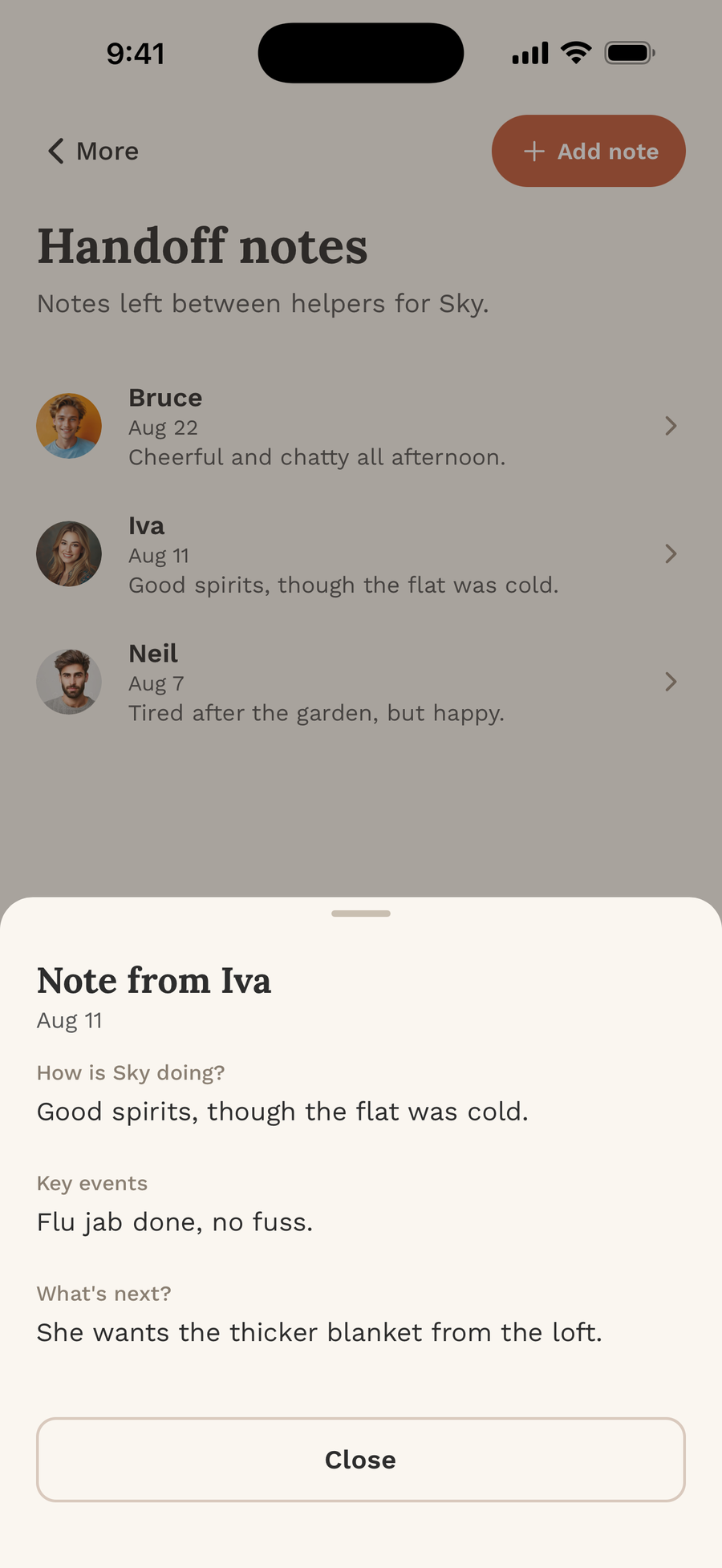
This is the pattern that led me to build FairNest in the first place — my own app, made for my own family's version of exactly this problem. Our shared Nest is where the week's coverage lives, where handoff notes land, where the whole family can see who's covering what without scrolling 63 messages to find out. It doesn't replace the Sunday Sync; it makes it possible, because the sync finally has somewhere to write things down. Take a look at getfairnest.com if your family's version of this ritual is still running on memory and text threads.
Bottom line
Bottom line: coordinating caregiving with siblings doesn't need a better group chat — it needs a rhythm. Fifteen minutes, five questions, one shared place where the answers live. Start this Sunday, keep it short, and let the chat go back to being a family chat.
The honest close
The group chat will never be a care plan. It's a junk drawer — useful, beloved, and completely untrustworthy for anything important. But fifteen minutes a week, five questions, one shared place where the answers live? That's a care plan.
FairNest is the family caregiving app I built for moments like these — a shared Nest for coverage, handoff notes, and everything the group chat keeps losing. It's free to try: download it on the App Store or on Google Play. We share caregiving tips daily over at our Instagram.