
The short answer: don't trust memory, the pharmacy, or a list on the fridge — build one shared, living medication list for your aging parent that every sibling can see and update the day anything changes, and mark each dose as given, skipped, or not sure. That's how you stop the "did anyone give Mom her morning pills?" spiral for good.
"Did anyone give Mom her morning pills?"
The text landed in our family group chat at 9:47 a.m. By 10:15, my brother and sister had each answered with a different guess, and nobody knew anything for certain. Mom, meanwhile, sat in her kitchen with her 28-compartment pill organizer and complete calm — she'd "taken care of it," and she genuinely believed that.
Here's the thing: we thought we had medications handled — we thought we knew how to manage an aging parent's medications. There was a list on the fridge. There was the organizer. There was the pharmacy that auto-refilled everything. We had all the artifacts of a system and none of the function of one.
When my family looked honestly at how we managed Mom's medications, we found we were running on myths — comforting beliefs that fell apart the moment a real question needed a real answer.
Myth 1: "Mom knows her meds."
Most people on five or more prescriptions can't accurately name every drug, dose, and timing from memory. That's not a judgment — memory is a terrible medical record, and it gets worse under stress, which is exactly the state you're in during a doctor's appointment or an ER visit.
The fix isn't interrogating your parent about their meds. It's taking the job of remembering off everyone's brain and putting it in one shared, living list: drug, dose, time, and what it's for.
Myth 2: "The pharmacy keeps track of everything."
The pharmacy knows what it dispensed. It doesn't know about the prescription Mom stopped taking on her own because it made her dizzy. It doesn't know the ER changed her dose last month. It doesn't know about the bottle from the old doctor still sitting in the cabinet next to the current ones — and it definitely doesn't know which of the two she's actually swallowing.
Nobody has the complete picture unless your family builds it. The pharmacy's records are a starting point, not the truth.
Myth 3: "Is a list on the fridge enough for medication safety?"
This was our big one. We had a typed list, laminated, stuck to Mom's fridge with a magnet shaped like a strawberry. It felt responsible. It was also six months out of date the day we finally questioned it — two medications added, one stopped, a dose changed, and the list serenely describing a regimen that no longer existed.
A static list goes stale the moment it's finished. What families actually need is a list that gets updated — where a change on Tuesday shows up for the sibling visiting on Saturday, and nobody's working from last spring's version of the truth.
Myth 4: "The pill organizer means we're covered."
The organizer is a container, not a record. It can't tell you who filled it, when, or whether the fill was right. In families with multiple helpers, that's a real gap: your brother fills it Sunday night, your sister visits Wednesday and finds Tuesday's compartment empty — but was the pill taken, or did someone forget to fill Tuesday at all?
You don't need surveillance — just the tiny habit of marking (taken, skipped, not sure) so the next person isn't guessing.
Myth 5: "Someone will handle it at the doctor's appointment."
Right, someone. The person at the appointment is the sibling who was free that day, working from memory and a blurry photo of a pill bottle. The doctor asks, "Any changes since last time?" and the honest answer is "I think my brother said something changed?" — and the doctor adjusts a dose based on a guess built on a guess.
The appointment goes completely differently when the person in the room can pull up the full, current list on their phone, including when each change happened.
How do you keep an aging parent's medication list accurate?
One living list, shared by everyone. Drug, dose, time, purpose. When it changes, whoever learns about the change updates it that day — not "before the next appointment," that day. One place, current, visible to the whole family.
Changes get dates. "Stopped the evening blood pressure pill — dizziness, Dr. Patel knows" is worth more than a perfect static list. A change log is what turns a list into a record.
Doses get confirmed. Whoever's there marks what was given, skipped, or uncertain. It takes ten seconds and it ends the "did anyone give Mom her morning pills?" spiral forever.
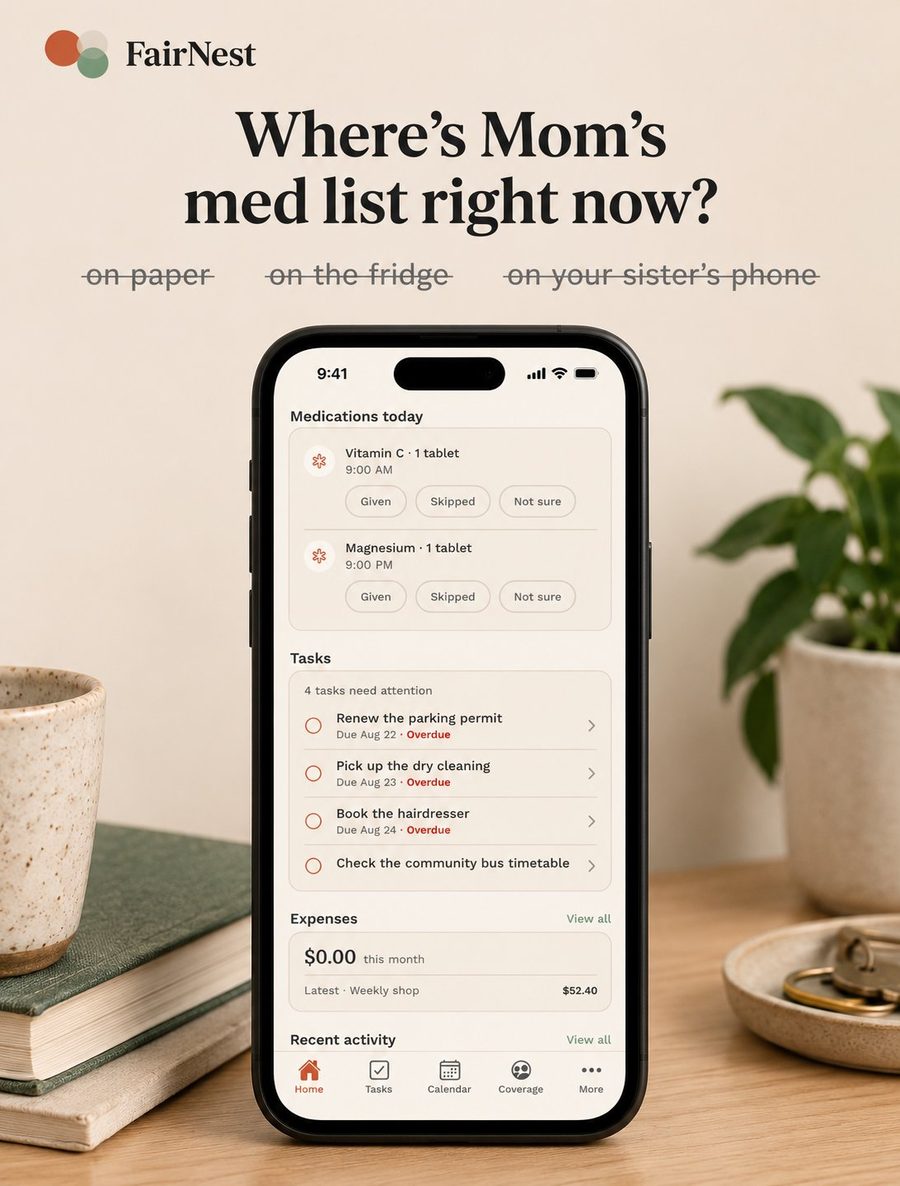 FairNest medication tracking: every dose gets marked Given, Skipped, or Not sure, so the whole family stops guessing.
The list goes to every appointment. Phone in hand or printed out. The sibling in the room goes from "I think" to "here it is."
This isn't medical advice — talk to your parent's doctor or pharmacist about what's right for them. It's just the unglamorous infrastructure that makes good care possible.
Why I built FairNest
I'm not writing this as a neutral observer. I built FairNest — my own app — after the morning-pills text that nobody could answer, because I wanted a shared Nest where our family's medication list could live and stay current: one list everyone sees, doses marked as given or skipped, changes visible the day they happen.
The morning-pills text still comes sometimes. Now the answer is in the app before anyone asks.
FairNest is free for iPhone and Android — grab it on the App Store here: https://apple.co/4xRXJuq or on Google Play here: https://play.google.com/store/apps/details?id=com.bizvizorllc.fairnest. And I share short, practical caregiving notes on Instagram at @fairnestapp.
Bottom line
Bottom line: the myths feel responsible, but none of them answers "did anyone give Mom her morning pills?" — only one shared, living medication list does, updated the day anything changes and marked dose by dose. Build that list tonight, and the guessing stops.
Start tonight
Tonight, do one small thing: pull every pill bottle out of the cabinet and write down what's actually there — name, dose, directions. Compare it against whatever list you've been working from. The gap between those two lists is the size of the myth you've been living in.
Then put the real list somewhere the whole family can see it and keep it alive. You can see how we handle this at getfairnest.com.
The myths are comforting. The list is better.